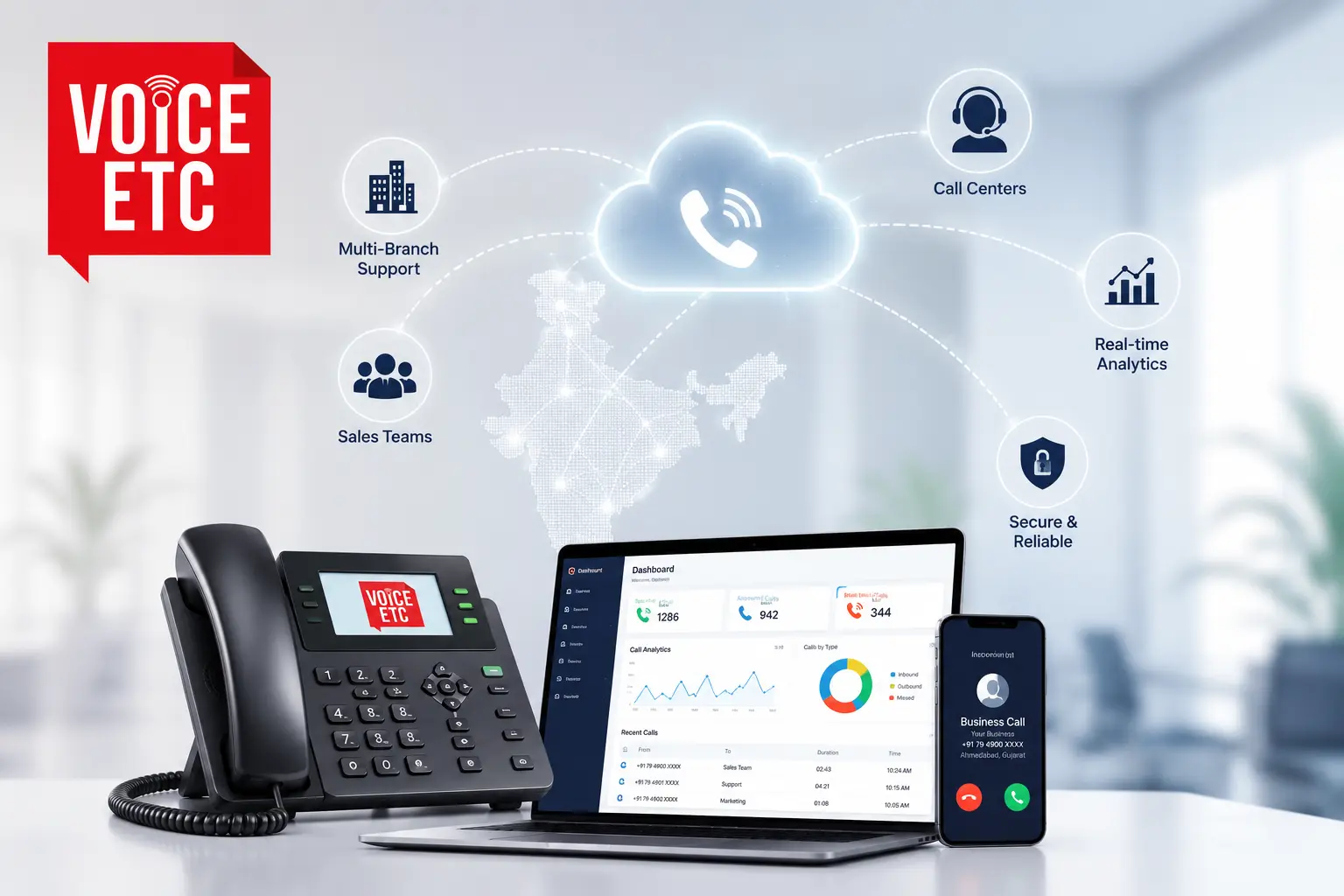
A cloud phone number is a business number that runs over the internet instead of a SIM card or a landline, so calls reach your team on whatever device they already carry. Voice ETC has been provisioning these numbers for Indian businesses from our Ahmedabad office since 2009. We supply local city numbers, toll free numbers, mobile format numbers and masked numbers, each one arriving configured with call routing, recording and reporting rather than bare. More than 800 businesses across India take their calls on a Voice ETC number.
What Is a Cloud Phone Number?
A cloud phone number is a business telephone number that lives on a provider's servers rather than inside a SIM card or a box on your wall. Someone dials it, the call travels over the internet, and the platform decides where to send it based on rules you set.
That is the whole idea, and it is why the rest becomes possible. One number can ring six people at once. It can send callers to sales during the day and to voicemail after seven. It can follow your office from Ahmedabad to Pune without a single customer noticing anything changed.
The naming is genuinely confusing and worth clearing up, because different providers sell the same thing under different words. Cloud phone number, cloud number, virtual number, online number and DID number all describe a business number that runs over the internet. If you have read four provider websites and come away with the impression there are four products, there are not. There is one product with four marketing names. What actually differs between providers is the platform behind the number, which is where routing, IVR menus and reporting either work well or do not.
How Do I Get a Business Phone Number in India?
Getting a business number in India is a documentation exercise more than a technical one. Every business number issued in the country has to be registered against a legal entity under TRAI and DoT rules, which is what separates it from buying a prepaid SIM at a corner shop.
The sequence is:
- Tell the provider what you need: number type, rough monthly call volume, and how many people will be answering
- Submit KYC documents, normally business PAN and address proof, along with an authorised signatory ID
- Pick your number from whatever is available in that city or series
- Set up routing, working hours and your call menu with the onboarding team
- Make a test call, then go live with dashboard access from the first day
Most delays happen at step two, not step four. Providers who collect documents after provisioning end up with numbers sitting inactive while paperwork gets chased. We verify documentation before allocating the number, which is dull but it is the reason activation timelines hold.
What Types of Cloud Business Numbers Can I Get?
Different jobs need different numbers, so we allocate by what the number is for rather than selling one line and calling it done.
|
Number type |
What it looks like |
Best suited to |
|---|---|---|
|
Local cloud number |
City STD code, such as 079 for Ahmedabad or 022 for Mumbai |
Businesses whose customers are concentrated in one city and expect a familiar code |
|
Toll free number |
1800 series |
Support helplines and enquiry lines where you want to remove the cost of calling you |
|
Cloud mobile number |
Ten digit mobile format |
Field and sales teams needing a shareable number without a company SIM for each person |
|
Masked number |
Temporary connector number |
Dealerships, brokers and marketplaces putting two parties on a call without either seeing the other's number |
Most businesses start with one and add a second inside a year. A property developer typically opens with a masked number for listing enquiries, then adds a toll free line once enquiry volume makes the free-to-caller argument worth paying for. A manufacturer usually goes the other way round.
How Much Does a Business Phone Number Cost in India?
Business number pricing in India has four parts, and comparing providers on the advertised monthly fee is the mistake that costs people money six months in.
Activation. A one time charge to allocate the number. A toll free number costs more to activate than a local one because 1800 series allocation carries extra regulatory steps.
Monthly platform fee. Covers access, a set number of agent seats and the feature tier. This is the figure on the pricing page.
Per minute usage. Charged past whatever minutes your plan includes. Inbound and outbound are priced differently, and calls to mobiles are priced differently from calls to landlines. If your team makes a lot of outbound calls, usage will overtake the platform fee, sometimes by a wide margin.
Number rental. A recurring charge per number you hold. This one catches out businesses running a separate number per city or per campaign, or holding a toll free number alongside their local ones, because it scales in a straight line with how many numbers you keep.
Ask any provider you are considering for a twelve month total across all four, calculated on your real expected volume rather than a sample. Then compare those totals. The headline plan price tells you very little on its own, and providers know it.
Can I Use a Cloud Number for Outbound Sales Calling?
Yes, and caller ID is the part that decides whether it works.
A small outbound team calling across several states runs into one problem before any other: an unfamiliar number from a distant city gets ignored. Showing a local number for the region being dialled changes pickup rates noticeably. It is not a subtle effect, and any team that has switched will tell you the same thing.
An outbound setup on a Voice ETC cloud number covers:
- Local caller ID selection, so the displayed number matches the region being called
- Click to call from your CRM or dashboard, so nobody is keying numbers by hand
- Automated dialling campaigns for list based outreach
- Agent level reporting: calls made, connect rate, talk time, outcome
- Recording on outbound calls, for coaching and for the occasional dispute
For a team of ten to fifteen agents doing cold outreach to Indian SMBs, that is usually the whole requirement. Local caller ID, a dialler, and numbers you can actually read at the end of the week. Teams that size rarely need skills based routing or workforce management, and there is no reason to pay contact centre pricing for features nobody will open.
Cloud Phone Number vs a Traditional Landline
|
Traditional landline |
Cloud phone number |
|
|---|---|---|
|
Hardware |
PBX and handsets on site |
None, runs on existing devices |
|
Setup |
Days to weeks, needs a technician |
Same day to one business day |
|
Location |
Fixed to the installed address |
Any device, any city |
|
Adding a person |
New line, new handset |
Added from the dashboard |
|
Changing call routing |
Engineer visit |
A few minutes, self service |
|
Call recording |
Extra hardware |
Included |
|
Reporting |
Call detail records |
Live dashboards with per agent data |
|
Moving office |
New number, new install |
Number moves unchanged |
The difference stops being theoretical the moment a business opens a second location. With a landline that means a fresh installation and a number nobody has ever dialled. With a cloud number it means adding a routing rule and telling nobody, because nothing visible has changed.
What Features Come With a Voice ETC Cloud Number?
- Call routing by agent availability, working hours, or what the caller picks from the menu
- Number masking on live calls, so neither side sees the other's real number
- Call recording with searchable logs, used for training and for settling disputes about what was said
- Multi device ring, so one number reaches a mobile, a desk phone and a laptop at the same time
- Missed call alerts by SMS, so enquiries arriving at eleven at night are still there in the morning
- Live dashboards covering call volume, agent performance and when your busy hours actually are
- API access for teams wanting calls triggered from their own systems
- Support you reach directly, without opening a ticket and waiting
That last one sounds like a small thing on a feature list. It is the reason most of our clients give when they tell us why they moved.
Which Businesses Use Voice ETC Cloud Numbers?
More than 800 businesses across India, and a clear pattern in which ones. The service earns its keep where a missed call has a price attached to it that somebody can calculate.
Hospitality. Lapinoz Pizza runs Voice ETC numbers across outlets. An unanswered call there is not a lost enquiry, it is a lost order, and the difference shows up in the day's takings.
Automobile dealerships. Masked numbers connect test drive enquiries to sales staff without exposing personal mobiles. There is a second benefit dealerships work out later: when a salesperson leaves, the lead history stays with the dealership rather than walking out on their phone.
Real estate. Enquiries from several listings route into one number, with campaign level tracking showing which portal or hoarding produced each call. Marketing budgets get argued over with data instead of opinion.
Manufacturing. Dealer and field networks spread across states reach one company number that routes by region, rather than everyone keeping a private list of mobile numbers.
Why Choose Voice ETC
Support without a ticket queue. Clients reach our team directly. If your enquiry line is your revenue line, waiting in a queue to change a routing rule is not a reasonable ask, and this is the complaint we hear most often about the providers people leave.
Working since 2009. Fifteen years of provisioning numbers inside the Indian regulatory system means KYC, TRAI compliance, and DoT paperwork are routine here rather than a surprise discovered halfway through onboarding.
Gujarat depth, national coverage. Our team sits in Ahmedabad and works closely with Gujarat's automobile, real estate, and manufacturing businesses. That shapes how we configure routing, because we have seen what these businesses actually do with their phones. Numbers themselves we provision anywhere in India.
Telephony and hosting together. Voice ETC also runs VPS, dedicated servers, and colocation, so businesses that would rather have one supplier and one phone number to call when something breaks can consolidate. Teams that want calls fired from their own software build on our voice API rather than working around the dashboard.
Get Your Cloud Phone Number
Tell us how your team handles calls now and we will map the number type, routing and reporting you actually need. Costed proposal inside one working day, no obligation.
Contact Voice ETC or call +91 90165 44566.