
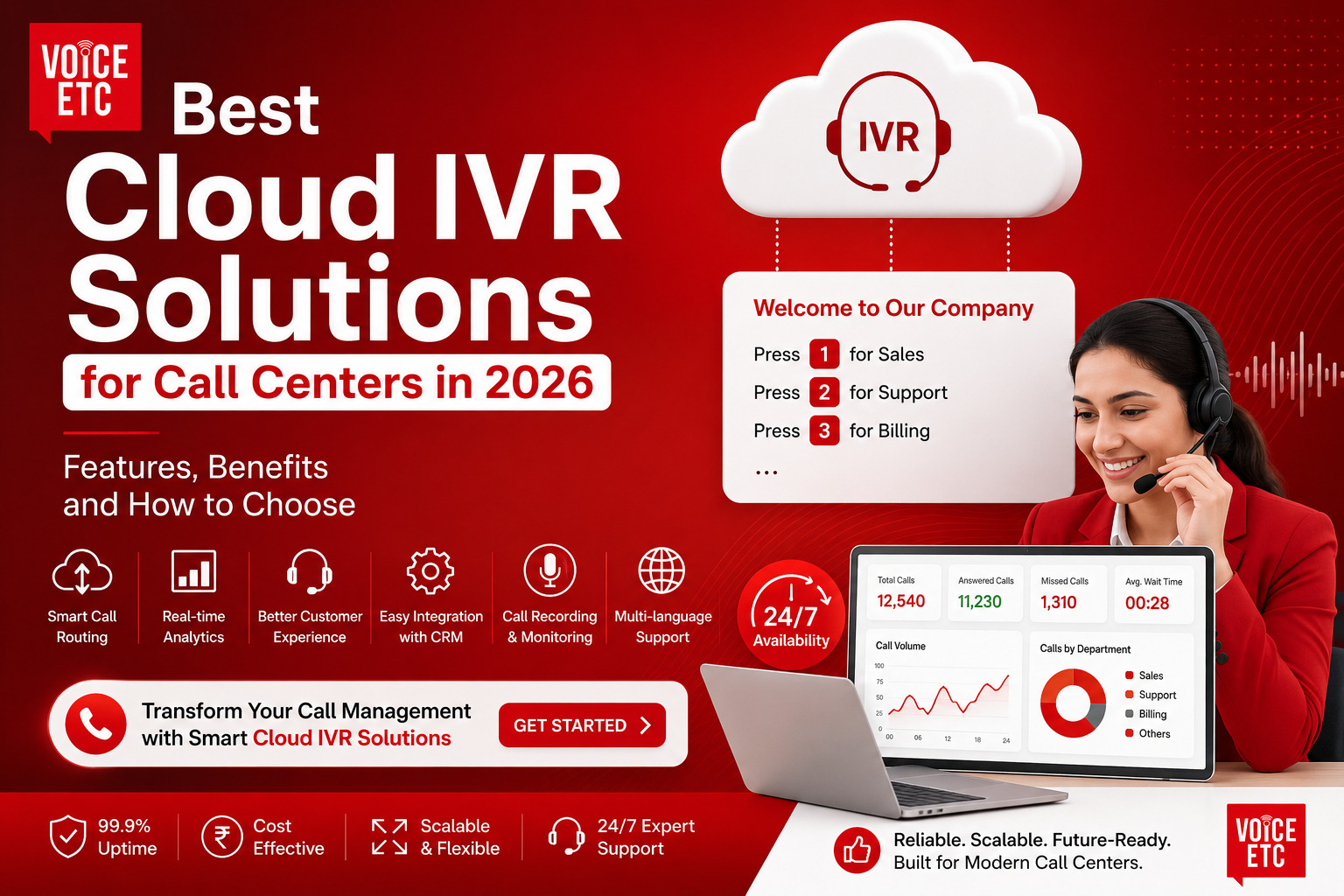
Best Cloud IVR Provider and Solution for Call Centers in 2026: Features, Benefits and How to Choose
If your business handles a significant volume of inbound calls, you already know what a missed call costs. Cloud IVR solutions help you stop missing them. They automate how incoming calls are dealt with, route customers to the proper person, and ease up the load on your team, no on-premise hardware is needed at all. In 2026, Indian call centers and SMEs are moving fast on this, and for good reason.
The Problem Most Call Centers Are Sitting With
Think about what happens when a customer calls your support line during peak hours and nobody picks up. They wait a bit, hang up, and call your competitor. This is not a rare edge case. This kind of thing happens thousands of times a day across Indian businesses. And the underlying issue is usually pretty consistent, call infrastructure that’s outdated, not really built for today’s call volumes, or for remote teams.
Most businesses are still running on traditional PBX systems or old on-premise IVR setups. These tools were built for a different era. Cloud IVR solutions replace that with something smarter: an automated system that answers every call, routes it based on real logic, and keeps customers engaged before an agent even picks up.
What Is a Cloud IVR Solution
A cloud-based IVR system is an interactive voice response platform that lives on remote servers rather than your office infrastructure. When someone rings in, they get a menu first, press a number or say a command, and then they're routed to the right group automatically. Compared to older IVRs, there’s no physical hardware to install or to keep maintained. You set everything up through a web dashboard, update call flows in minutes, and scale up or down on demand without purchasing additional equipment. Key capabilities typically include the following:
- Multi-level IVR menus with tailored greetings
- AI-driven call routing using caller history and intent
- Live analytics and detailed call reporting
- CRM integration so every call has full customer context
- Support for multiple languages including Hindi, Gujarati, Tamil and more
- Call recording plus quality monitoring
- Toll-free number and virtual number integration
How Does a Cloud Based IVR System Work
When a customer calls your business number, the call usually heads to the cloud IVR setup first . That system plays a greeting and then basically throws a few choices at the caller, like press 1 for sales or press 2 for support, and whatever they select is what decides where the call goes next, to the right team or the right agent. If no agent is available, the system can take a message, offer a callback, or play hold music.
All of this happens automatically. Your agents do not need to sit near a physical switchboard. They can be working from the office, from home, or from multiple locations across India. The calls can reach people on their phones or computers, wherever they are , kind of anytime.
The “cloud” part is the key bit. The actual IVR software runs on remote servers that are kept up by your IVR provider. You do not install it on your side, instead you manage it through a web dashboard. From there you can review call recordings , track how many calls came in today, see who is available right now, and even update your IVR menu options whenever you want, without needing extra technical help.
Key Features to Look for in a Cloud IVR Provider
Not every cloud IVR provider gives you the same kinds of tools. So before you commit for your call center, it pays to check what’s included and what is missing, and then decide.
Multi-level IVR Menus
A solid cloud IVR platform lets you create menus that go beyond just one screen. Think multiple layers . The first level can ask which department they need, and the next level can ask something more specific inside that department. This helps reduce misrouted calls, so fewer calls end up on the wrong team. Everyone saves time, including the customer.
CRM Integration
When your IVR connects with your CRM, your agents get context before the conversation even starts. Instead of waiting , they can see the caller’s prior history as soon as the call arrives. The system can recognize the caller by their phone number , and then pull up things like account information, earlier tickets, and previous communications, so agents can jump in faster.
Call Recording and Analytics
Every call should be recorded and stored securely. Your managers need to be able to go back and listen to any conversation for quality checks or dispute resolution. Analytics show you the busiest hours of your day, average handling time, calls missed, and how many callers dropped before speaking to anyone. These numbers help you improve staffing and reduce missed business.
Intelligent Call Routing
More advanced cloud IVR services route calls using more than just the option the caller pressed. You might be able to route based on time of day, caller location, language choice, the agent with the smallest queue, or even the agent who handled the caller’s last interaction. It’s more organized than simple menu matching , and it usually improves customer experience.
Scalability
During a product launch, a sale season, or a crisis, your inbound call volume can spike by two or three times overnight. A cloud based IVR system scales with you. You do not need to buy new hardware or wait weeks for an engineer to install extra lines. You simply add more capacity through your dashboard and you are ready in minutes.
Toll-Free and Virtual Numbers
Your cloud IVR provider should be able to give you toll-free numbers that callers can reach you on without paying for the call themselves. This increases the number of people who actually call in with inquiries.Virtual numbers with local area codes for different cities can also help your business appear local to customers across India.
Cloud IVR vs Traditional IVR
Here is a quick comparison of how the two stack up:
|
Factor |
Traditional IVR |
Cloud IVR |
|
Setup Time |
Weeks to months |
Hours to a few days |
|
Hardware Cost |
High upfront investment |
Zero hardware required |
|
Scalability |
Limited by hardware |
Scale up or down instantly |
|
Remote Access |
On-site only |
Fully remote |
|
Maintenance |
Requires dedicated IT |
Managed by provider |
|
Uptime |
Depends on local infra |
99.9% SLA-backed |

Best Cloud IVR Solutions for Call Centers in India
India has become one of the fastest growing markets for cloud IVR adoption, and it is not hard to see why. Call centers, BPOs, real estate firms, healthcare providers and ecommerce businesses across cities like Ahmedabad, Mumbai, Delhi and Bangalore are replacing old on premise systems with cloud based setups that are faster to deploy and easier to scale.
For businesses operating in India, a good cloud IVR solution needs to do a few things well. It should support regional languages like Hindi, Gujarati and Tamil so callers feel like they are talking to a local team. It should work reliably on Indian telecom infrastructure without call drops or routing delays. And it should come with local support, someone who actually understands TRAI regulations and can help you set things up without back and forth with an overseas helpdesk.
Voice ETC has been building cloud IVR systems for Indian businesses since 2011, with the kind of local language support, India specific routing and on ground support that international platforms often struggle to deliver. If you want to see how it fits your call flow, you can request a quick walkthrough with the team.
Why Indian Businesses Are Moving Fast on This
India has one of the most intricate customer support landscapes anywhere in the world, and it is not even close. You got BPOs, e-commerce companies, real estate firms, healthcare providers , and banks all leaning on inbound call management day to day. Now a few things make the move to cloud IVR feel extra relevant, like right now, not later:
- Remote and hybrid work is basically standard now, so teams need call infrastructure that holds up from anywhere, even home desks and coworking spots
- Customers want an immediate, professional response the second they reach you, not a “please wait” loop
- Startups, and also the growing businesses, want enterprise-grade call handling without the usual capital expenditure, which is kind of the whole point
- Lots of customer groups are multi-lingual, so the IVR should actually speak their language, literally not in some “almost” way
- In BFSI and healthcare, compliance needs often include call recording, so the system has to behave and document things properly.
In fact, businesses from Ahmedabad-based real estate developers to pan-India automobile distributors are already running on cloud IVR. This is not a future trend. It is the present reality.
Features That Actually Matter
Every provider will use the same buzzwords. What separates strong platforms is dynamic routing that sort of considers time of day, caller history, department availability, and agent skills, all together.
- CRM integration: your IVR is only useful if it actually touches your customer data. So look for platforms with ready integrations for Zoho, Salesforce, Freshdesk, Leadsquared, and also custom API support.
- Multi language support: for Indian businesses, this is non negotiable. A caller from Tamil Nadu should hear Tamil. A caller from Gujarat should get Gujarati. This kind of thing has a direct effect on call completion rates too.
- Real time analytics: Live dashboards showing call volumes, wait times, drop-off rates, and agent performance give your operations team the visibility they need to improve continuously.
- Uptime and reliability: an IVR that goes down during business hours is worse than having nothing at all. So verify the provider gives you a 99.9 percent uptime SLA, plus redundant infrastructure, not just “best effort."
What to Watch Out For When Choosing a Provider
A few common gaps come up again and again when evaluating cloud IVR vendors:
- Pricing opacity: the feature tiers are listed, but per-minute call rates, setup fees, and extra add-on charges can be hidden. Always ask for a full cost breakdown.
- Overpromised AI: the words “AI-powered IVR” get tossed around pretty loosely. Confirm if the platform truly uses natural language processing or if it’s basically DTMF-based menu selection.
- Weak onboarding support: self-serve setups can work for simple flows, but once you have three or more levels, you will need hands-on implementation help.
- No India-specific optimization: some international platforms struggle with Indian PSTN infrastructure, and that can lead to call quality problems or routing delays, in plain terms.
- Lock in contracts: watch for long-term agreements that come with steep exit clauses, especially if you can’t migrate easily later. Prefer providers offering flexible monthly plans.
The ROI Question
A business handling 300 inbound calls a day on a basic phone line will miss 20 to 30 percent of those calls during peak hours. At a conservative lead value of Rs. 500 per missed call, that is Rs. 30,000 to Rs. 45,000 in potential revenue lost every single day.
A cloud IVR system running at Rs. 3,000 to Rs. 8,000 per month captures those calls, routes them correctly, and gives your team the context to convert them. Beyond that, you save on receptionist dependency, training costs, and compliance management through automated recording. The math is straightforward once you run it honestly.
How to Choose the Right Provider
A practical framework for evaluating options without getting lost in feature lists:
- Map your call flow before talking to any vendor. Know your volumes, peak hours, departments, and language requirements.
- Ask for a live demo using your actual call scenarios, not a generic walkthrough.
- Confirm integration support for every tool your team uses right now, like the CRM, ticketing, analytics, or whatever else. Also verify it, don’t assume.
- Verify uptime guarantees, and please ask very explicitly what happens during a downtime event. For example, do calls queue, do they reroute, do they fail over to a backup number, and for how long?
- Request a full cost breakdown, including per-minute rates, setup fees, and any add-on charges. Make sure it’s all itemized and not just a vague “starting at” number.
- Check whether the provider has local support, not just a remote helpdesk, who actually understands Indian telecom infrastructure and also the TRAI regulations.
Frequently Asked Questions
What is a cloud based IVR solution?
It is this automated call handling setup, hosted on remote servers somewhere in the cloud. It talks to the caller first, then throws in menu choices, and finally sends the call to the correct team based on what the caller presses or says. There's no on-site gear to install, you usually just manage the whole thing from a web dashboard, which is pretty convenient.
How much does cloud IVR cost in India?
Cloud IVR pricing in India commonly falls somewhere around Rs. 1,500 to Rs. 10,000 per month. The actual figure depends on call traffic, included capabilities, and who the provider is. The starter plans tend to be cheaper, while bigger packages, especially those with AI-style routing, CRM connections, and priority or dedicated support, cost more. Before you go ahead, try to ask for the full pricing sheet and a clear cost breakdown, because “per month” alone can be a bit misleading sometimes.
Is cloud IVR suitable for small businesses?
Yes, actually, it tends to fit small businesses really well. For a small team, it can be a big upgrade in day-to-day operations. Imagine a startup with five people, it can still manage calls politely and route questions to the right staff member, giving the same kind of perceived professionalism you’d expect from a much larger organization. You don't need a dedicated receptionist, and you avoid hardware-type investments too.
Can cloud IVR integrate with CRM software?
Yes, most current platforms support CRM integration. You can typically connect with Zoho CRM, Salesforce, Leadsquared, Freshdesk, and more using built-in connectors or REST APIs. After that, the system can show agents relevant info in an automatic “screen pop-up," log call details directly inside the CRM, and even make routing choices based on what the customer already did before.
what are the best ivr solutions for remote and hybrid call centers?
Voice ETC provides enterprise grade cloud IVR solutions that are built with remote and hybrid call centers in mind, so support teams can handle incoming customer calls from wherever they are, and still keep the experience steady with solid quality, too.
Which cities does Voice ETC support for cloud IVR?
Voice ETC supports businesses across India including Ahmedabad, Mumbai, Delhi, Bangalore and other major cities, with virtual numbers and local routing available so your business can appear local to customers wherever they are calling from.
Where to Go From Here
If you are still running on a legacy PBX or a cloud IVR that was set up years ago and never updated, now is a good time to take stock. Map your current call flow, find where calls are dropping, and check how long customers are waiting. Those gaps tell you exactly what your setup is missing.
Voice ETC has been working with Indian businesses across real estate, automobile, hospitality, and BPO sectors since 2011. If you want to understand how a cloud IVR solution would fit your specific call flow, the team is available for a no-pressure walkthrough.