
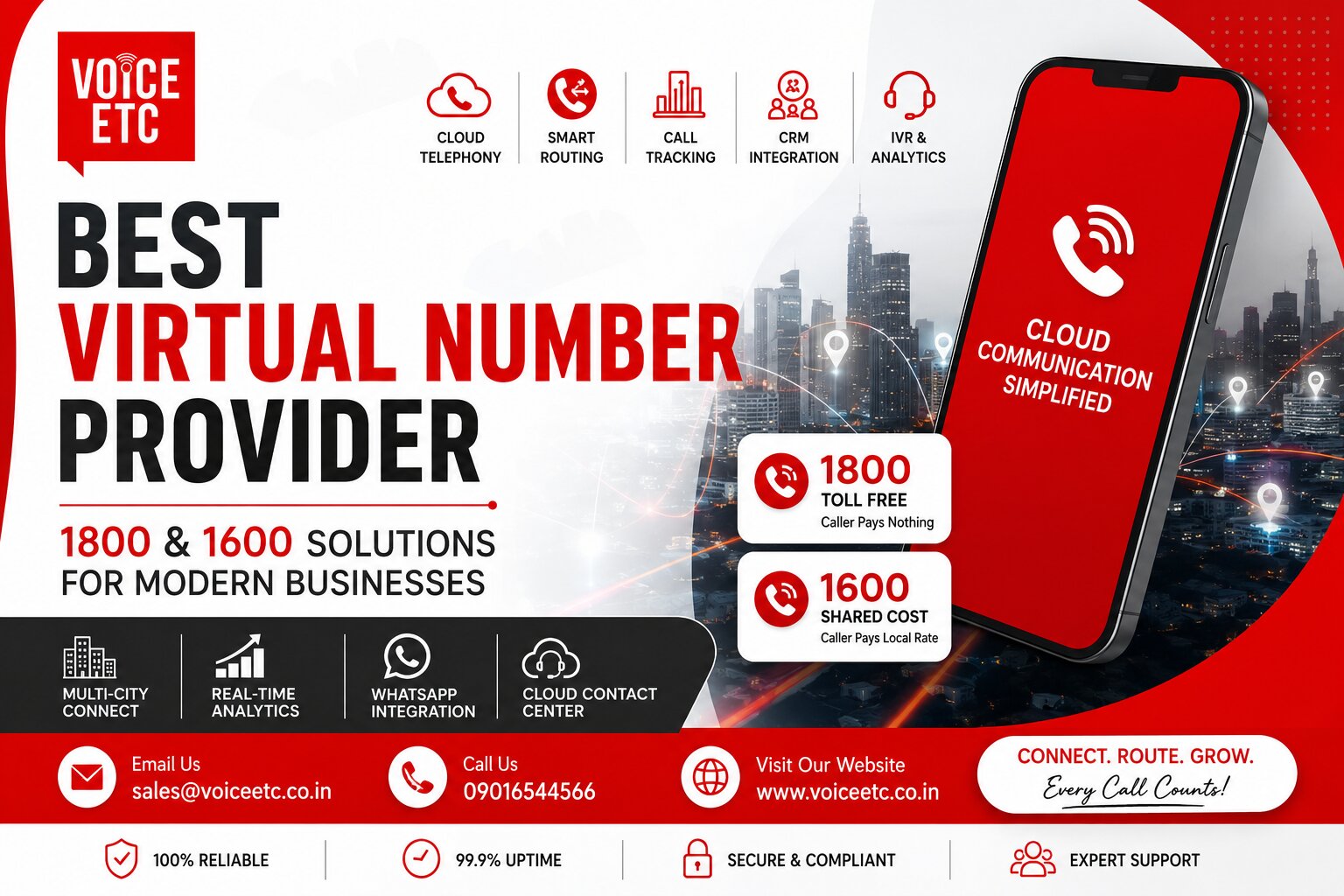
Best Virtual Number Provider and Toll Free Number Solutions for Businesses in 2026
A virtual number provider gives your business a cloud-hosted phone number that needs no SIM card or physical hardware. Calls come in, route to the right team, and your customer has no idea whether your agent is in Mumbai or Mehsana. Toll free virtual numbers go one step further by removing the cost barrier for callers, which matters in India where customers still think twice before dialling a number that might charge them. In 2026, businesses from Ahmedabad startups to Delhi-based BPOs are using virtual business phone numbers to answer more calls, track leads by source, and run support teams spread across multiple cities without missing a beat.
Why Businesses Keep Losing Calls They Do Not Even Know They Lost
A customer sees your ad, pulls up your number, and either decides not to call because the number looks expensive or dials in and gets a busy tone because your two-person team is already occupied. Neither of those events shows up anywhere in your sales data. They just vanish.
This happens daily across real estate offices, automobile showrooms, clinics, and e-commerce support teams all over India. A virtual 1800 number with proper call routing directly addresses this. Every call gets answered or logged. No lead disappears quietly.
What You Actually Get With a Virtual Business Phone Number
Skip the technical definition. Here is what changes on day one:
- One number working across multiple cities, agents, and devices with no hardware changes
- Routing logic you can update from a browser in under five minutes
- Full call tracking showing which campaign, city, or channel each call came from
- CRM integration so every inbound call creates or updates a contact record automatically
- Call recordings stored in the cloud with search and playback by date, agent, or number
- WhatsApp or SMS fallback when a call is missed or outside business hours
- Live dashboards showing call volumes, wait times, and agent answer rates
The scaling point matters most for growing businesses. Adding phone capacity on a traditional PBX means calling a vendor and waiting for hardware. On a virtual call management system, it takes a few clicks. A team going from ten to fifty agents over a year does not need a single telecom visit.
1600 vs 1800 Toll Free Numbers in India: The Difference That Most Providers Skip Over
This is where most competitor pages either stay vague or skip the topic entirely. Here is what actually matters for your decision.
|
Factor |
1800 Toll Free |
1600 Toll Free |
|
Who pays for the call |
Caller pays nothing, business absorbs cost |
Caller pays local rate, business pays less |
|
Reachable from mobile |
Yes, mobile and landline both |
Landline only, not from mobile phones |
|
Best suited for |
Sales helplines, support, pan-India campaigns |
Regulatory helplines, government and utility bodies |
|
Cost to business |
Higher, full call cost absorbed |
Lower, shared cost model |
For most Indian businesses, 1800 is the right call. The reason is blunt. The majority of your customers are calling from smartphones. A 1600 number is unreachable from mobile phones entirely. If your campaigns run on digital platforms and your customers are mobile-first, a 1600 number makes you inaccessible to most of them before the conversation even starts.
What Providers Are Not Telling You Before You Sign
After reviewing how Exotel, Knowlarity, MyOperator, Ozonetel, CallHippo, and Tata Tele present their virtual number products, three gaps show up every time.
Pricing pages hide the real cost. The headline subscription fee does not include per-minute inbound rates on toll free calls, add-on fees for call recording or analytics, or overage charges when you exceed your monthly call limit. Get a fully itemised quote covering your expected call volume before you commit to anything.
Setup takes longer than advertised. Activating a number takes minutes. Configuring routing logic, setting up multi-language greetings, testing CRM integration, and going live properly takes a day or two minimum for any business with more than a basic call flow. Ask upfront whether onboarding support is included or billed separately.
Some international providers are not optimised for Indian PSTN infrastructure. That shows up as latency, routing delays, and call quality issues on domestic calls. Check whether the provider has Indian data centers and ask for references from Indian businesses specifically.
How This Connects to Your Broader Communication Setup
A virtual number handles inbound calls. Connected to the right stack, it does considerably more.
Pair it with a cloud IVR solution and you add multi-level menus, self-service options, and real-time call analytics. Callers reach the right department faster, and your team handles fewer repetitive queries.
Connect it to a cloud contact center platform, and your agents get a unified workspace with full call history and customer records on screen before they even say hello.
Add WhatsApp Business API, and missed calls trigger an automatic WhatsApp follow-up. In India, where WhatsApp is the default messaging app for most people, that fallback converts far better than a voicemail ever will.
Tie everything together with a VoIP telephony system, and your agents can work from anywhere, a home office, a satellite location, or a coworking space, with the same call quality and the same data feeding into the same dashboard.
A Practical Checklist Before You Choose a Provider
- Map your daily call volume and peak concurrent calls before any vendor conversation
- List the departments, languages, and time-slot routing requirements you need
- Confirm local DID availability for your specific cities
- Request a full cost breakdown, including per-minute inbound rates and add-on fees
- Test call quality from both mobile and landline before signing anything
- Verify CRM integration compatibility with your actual tools
- Ask about uptime history and incident response time specifically
- Confirm regional language IVR availability if your callers are multilingual
Frequently Asked Questions
1. What is a virtual number provider?
A virtual number provider is basically a cloud telephony company like Voice ETC that gives businesses a phone number, but it is hosted on remote servers instead of being tied to a physical SIM or a landline. That number receives incoming calls and then sends them along to whatever device or person you want. Usually the business controls routing, call recordings, and analytics through a web dashboard, so there’s no real hardware work involved, or at least no complicated setup.
2. How does a toll-free virtual number work?
When a customer dials your 1800 number, the call goes through the provider’s cloud network, and it follows the routing rules you configured. Then it connects to the right agent or department, often with recording done automatically, and the call details are captured and logged. From the caller side, there is no charge. From the business side, the provider bills you based on call duration and your monthly usage volume.
3. What is the difference between 1600 and 1800 toll free numbers in India?
A 1800 number is fully toll-free for the caller, and it can be dialed from both mobile phones and landlines. In this case, the business covers the full call cost. A 1600 number works under a shared cost model, meaning the caller pays a local rate, and there is a big limitation: you cannot dial it from a mobile phone at all. So if your customers are mostly using smartphones, 1800 is the practical choice, not 1600.
4. Can small businesses use virtual toll-free numbers?
Yes, and honestly this is one of the most solid use cases. A small business can put forward an 1800 number, route those calls using a professional greeting, and operate like a bigger company, right from day one. No hardware to purchase, no annoying long-term contracts required, and the whole setup can scale when your team gets larger.
5. How much does a toll-free number online cost in India?
Basic plans start from around Rs. 1,000 to Rs. 5,000 per month. Enterprise pricing goes higher depending on concurrent channels and feature requirements. The base plan is never the full story. Per-minute inbound rates on 1800 calls vary significantly across providers and can add up fast at higher volumes. Always ask for a complete cost sheet before deciding.
One Last Thing
If your current phone setup is missing calls, routing them to the wrong person, or giving you no data to work with, fixing that is simpler than most businesses expect. The technology is mature, the pricing is accessible, and the setup timeline is short.
Voice ETC has worked with Indian businesses across real estate, automobile, education, healthcare, and BPO since 2011. If you want to talk through your call setup and understand what a properly configured virtual number solution would look like for your team, that conversation requires no commitment. Just a call.