
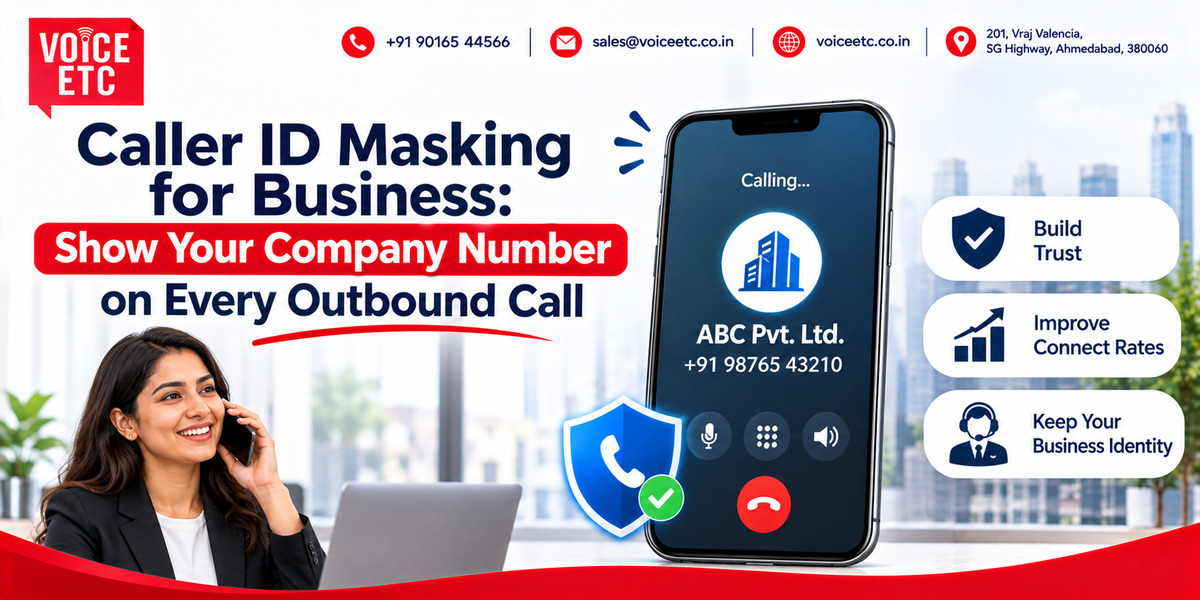
Caller ID Masking for Business: Show Your Company Number on Every Outbound Call
By Voice ETC Team | Published: 20 November 2026 | Updated: 20 November 2026
Voice ETC provides caller ID masking for Indian businesses that want every outbound call to carry one company number instead of an employee's personal mobile. Your sales and service staff keep calling from the phones already in their pockets, yet the customer sees a number that belongs to your business, can be saved under your brand, and always leads back to your team. Plans include two-way masking and unlimited calling from Rs 1,200 per user per month plus GST, and most accounts are live within 24 hours.
This guide explains how outbound caller ID masking works, how to plan caller IDs across teams and branches, what India's new caller name rules under CNAP mean for business calls, and where the legal line sits between masking and caller ID spoofing. Voice ETC has built business calling systems from Ahmedabad since 2009 and serves more than 800 businesses across India, so the advice below comes from setups we run every day.
What Is Caller ID Masking?
Caller ID masking is a calling setup in which the receiver's screen shows a business number allotted to your company, rather than the personal or direct number of the employee who placed the call. The conversation connects like any other phone call. Only the identity on the screen changes, and it changes to a number the business owns and controls.
In practice, it means a customer sees the same company number whether the call comes from your branch manager, a sales trainee in their first week or a field executive standing at a site. At Voice ETC, caller ID masking is part of our call masking service, which also keeps the customer's number off your staff's phones so that every lead stays in the company account.
What Is Outbound Caller ID?
Outbound caller ID is the number, and on some networks the name, that appears on a customer's phone when your business calls them. Inbound caller ID works the other way round: it is what your staff see when a customer rings in. A masking platform can control both directions, but most businesses feel the pain on outbound calls first, because that is where rejected calls and leaked numbers cost real money.
Caller ID Number vs Caller ID Name: What Does the Customer Actually See?
A caller ID display has two parts. The first is the number, which the network carries on every call. The second is the caller ID name, the line of text telling the receiver who is calling. Until recently, Indian phones showed a name only when the number was saved in the receiver's contacts or flagged by a third-party caller ID app. That is changing with Calling Name Presentation, which we cover in its own section below.
Caller ID masking decides which number your customers see. The name that appears next to it comes from the telecom operator's records for that number, or from the customer's own contact list once they save you.
Why Do Business Calls From Personal Numbers Go Unanswered?
Indian phone users have learned to treat unknown numbers with suspicion. A July 2026 industry report on business calling in India found that close to eight in ten people avoid business calls from numbers they do not recognise. When your executive dials from a personal mobile, the customer sees ten random digits with no link to the brand they enquired with, and a large share of those calls are declined or left to ring out.
Personal numbers cause three more problems that show up weeks later:
- Customers who do answer save the executive's number, not the company's, so repeat business follows that phone when the executive resigns.
- As a lead passes between staff, the customer gets calls about the same enquiry from three or four different numbers, which looks disorganised and sometimes like fraud.
- Managers cannot see which leads were called, how long each conversation lasted or what price was quoted.
A single business caller ID fixes the first impression and the record-keeping in the same move.
How Does Caller ID Masking Work for Outbound Calls?
A masked outbound call is placed through the calling platform instead of being dialled directly from the handset. The platform links your employee and your customer as two connected call legs and presents your business number to the customer as the outbound caller ID. Your employee's real number is never sent to the customer's phone.
What Happens When an Executive Calls a Lead?
- The executive opens the lead in the Voice ETC dashboard, your CRM or your app and taps the call button. Nobody types the customer's number into a personal phone.
- The platform first calls the executive's own mobile, so they can keep using the handset they already have.
- As soon as the executive picks up, the platform places the second leg to the customer with your business number set as the caller ID.
- The customer sees a company number, answers, and both legs are bridged into one conversation.
- The call is saved against that user with its time, duration and outcome, and a recording if recording is switched on.
From the customer's side, nothing feels unusual. They receive an ordinary call from a number that belongs to the business they contacted.
Where Can Masked Outbound Calls Start?
Most teams use two or three starting points rather than one:
- The Voice ETC dashboard, for staff who work through a daily follow-up list.
- Your CRM, so each call begins on the lead record and the result is written back to it.
- A click-to-call button on your website or inside your own software, which connects a customer with your team without either side seeing a personal number.
- Your mobile or web app, for marketplaces and service platforms that connect customers with partners, riders or technicians.
None of these integrations is required on the first day. Masked calling works from the dashboard immediately, and you can add CRM or app connections once the team is comfortable with the new way of calling.
What Happens When the Customer Calls Back?
A customer who misses your call will often ring the number back an hour later. With caller ID masking, that callback reaches your business instead of a stranger or a switched-off phone. You choose where it goes: directly to the executive who made the call, to the team that owns the lead, or through a short cloud IVR menu that asks whether the caller wants sales or service. If the original executive has left the company, the call still lands with whoever is now handling that customer.
This callback loop is the part many businesses underestimate. A missed outbound call from a personal mobile is usually a lost conversation. A missed call from a masked business number is a warm lead calling you back.
Caller ID Management: Which Number Should Each Team Show?
Caller ID management means deciding which business number each person or team presents, and keeping that decision consistent as staff, branches and campaigns change. A small business often needs just one number. Larger teams usually split numbers by purpose, so that customers can tell from the screen what the call is about.
One Company Number for Every Outbound Call
This suits owner-led businesses and sales teams of up to a dozen people. Every call shows the same number, customers save it once, and your website, invoices and visiting cards all carry the number that actually calls them. It is the simplest way to build recognition fast.
Separate Caller IDs for Sales, Service and Collections
A customer who has saved your number as "service" answers it expecting help with an existing order or booking. Use that same number for a sales pitch and you teach them to ignore it. Keeping separate numbers for sales, after-sales service and payment follow-ups protects the answer rate of each one. Voice ETC lets you give each user or each team its own virtual business number, and change that mapping whenever your structure changes.
Local Caller ID for Branches and Cities
Local caller ID means showing a number that customers connect with their own city or branch. A dealership group with showrooms in Ahmedabad and Vadodara, for example, may want each branch's calls to show a branch number, so that callbacks go straight to the right showroom rather than a central desk. The number series available in each city can vary, so confirm your branch locations on the demo call and we will tell you what can be allotted. Businesses based in Gujarat can also read how phone number masking in Ahmedabad works for local sales and service teams.
Reassigning a Caller ID When Someone Leaves
A masked number at Voice ETC is not tied to one employee for life. You can move it to a colleague, or replace it with a new number, whenever you need to. The customer keeps calling the same number and simply reaches the person now responsible for them, which is exactly what you want when an experienced executive hands over a hundred open leads.
Virtual Caller ID vs Custom Caller ID vs Hidden Caller ID
These three terms are often used loosely on product pages, and the differences matter in India because of how the law treats the number on the screen.
| Option | What the customer sees | Callback reaches | Position in India | Best for |
|---|---|---|---|---|
| Personal mobile | The employee's own number | The employee, even after they leave | Legal | Sole owners who handle every call themselves |
| Virtual caller ID (masked business number) | A business number allotted to your company | Your business, routed as you choose | Legal when the number is allotted to you through a licensed provider | Sales, service and field teams |
| Custom caller ID showing any number you type in | A number the caller has picked, which may belong to someone else | Whoever actually holds that number | Presenting a number not allotted to you is tampering with a telecom identifier | Not suitable for Indian businesses |
| Hidden caller ID | "Private number" or "Unknown" | Nobody, the customer cannot call back | Legal for personal use | Rarely useful for business calling |
A virtual caller ID is simply one of your business's virtual numbers used as the outbound identity on masked calls. Global calling tools often advertise custom caller ID as a free choice of display number. In India, the number you present must be one allotted to your business, which is why Voice ETC only presents numbers it has allotted to your account.
CNAP in India: Can Your Business Name Show on Caller ID?
Yes, in many cases. Under India's Calling Name Presentation (CNAP) service, the name shown on an incoming call comes from the telecom operator's subscriber records, and holders of business or bulk connections can ask their operator to display a registered brand or trade name instead. The operator checks the documents before the name goes live.
What Is Calling Name Presentation (CNAP)?
CNAP is a network-level caller ID name service that shows the caller's name along with the number on the receiving phone, using the name held in the caller's telecom KYC records. Through a circular dated 13 October 2026, the Department of Telecommunications directed operators to switch CNAP on across their service areas from 1 November 2026. Key points of the rollout:
- It is on by default for users on 4G and newer networks, with no need to opt in. Rollout on 2G, 3G and landline connections is being looked at separately.
- Names that a customer has saved in their own contacts are not replaced.
- Callers who have activated caller ID restriction are exempt.
- The service follows TRAI's recommendations of February 2024, and TRAI's October 2025 position that CNAP should be on by default.
Whose Name Appears on a Business Call?
By default, the name attached to the connection in the operator's records. For a business connection, that is usually the legal entity that bought it. If your company is registered as a private limited firm under one name and trades under a different brand, customers may see a name they do not recognise, which defeats the purpose.
How Can a Business Display Its Name on Caller ID?
Business and bulk connection holders can request a preferred name in place of the name in the subscriber records. Under the DoT rules, the preferred name must be backed by one of two registrations.
A Trademark Registered With the Trade Marks Registry
If your brand name is a registered trademark in your company's name, it can be used as the displayed caller ID business name, subject to the operator's document check.
A Trade Name Registered on the GST Portal
If the name customers know is the trade name on your GST registration, that can serve as the supporting record instead.
In both cases the operator verifies the documents before activating the name, and any later change needs a fresh request. Before you apply, check that the name on your trademark or GST record matches the name on your showroom board, website and ads. A mismatch here is the most common reason a business ends up displaying a name customers do not connect with the brand.
CNAP, Verified Caller ID and Masked Calls
Caller ID masking and CNAP solve two halves of the same trust problem. Masking controls which number your customers see. CNAP controls which name the network attaches to a number. Voice ETC caller ID masking does not add a CNAP name or a verified badge to masked calls today.
What masking does give you is one consistent business number on every call, and consistency is what turns a number into something customers recognise. Publish that number on your website, Google Business Profile, booking confirmations and invoices, and ask customers to save it under your brand name at the first conversation. Paid verified business profiles on third-party caller ID apps, and business name display services sold by telecom operators on their own enterprise connections, are separate products with their own eligibility rules.
Verified Business Calls in India: 1600, 1601 and 140 Series Explained
Alongside CNAP, TRAI has reserved dedicated number series so that people can tell genuine service calls apart from promotions. If your business falls into one of these categories, a masked ten-digit number is not a replacement for the designated series.
| Series | Who uses it | What it is for | Key rule |
|---|---|---|---|
| 1600 | Regulated banking, financial services and insurance entities, and government bodies | Service and transactional calls | Apps cannot tag, filter or block calls from this series |
| 1601 | Utilities, courier and logistics companies in the first phase, from August 2026 | Service and transactional calls | Allotted only against an undertaking that it will not be used for promotional calls |
| 140 | Registered entities from any sector | Promotional calls | Customers can block promotional calls by sector through the DND registry |
For most small and mid-sized teams in automobile, real estate and hospitality, the calls that matter are follow-ups to people who enquired, appointment and visit confirmations, and after-sales service. Those run on regular business numbers, and that is where caller ID masking fits. Cold promotional calling to people who never contacted you is a different activity, governed by TRAI's commercial communication regulations, and changing the displayed number does not change those obligations.
Caller ID Masking vs Caller ID Spoofing
Both change what appears on the customer's screen, which is why people confuse them. The difference lies in whose number is shown and why.
| Point | Caller ID masking | Caller ID spoofing |
|---|---|---|
| Number shown | A number allotted to your business | A number the caller does not hold |
| Provided through | A licensed calling platform | Spoofing apps, tampered routes or illegal setups |
| If the customer calls back | They reach your business | They reach someone else, or nobody |
| Purpose | Privacy, a consistent identity and lead control | Hiding the caller's identity or impersonating someone |
| Traceability | Every call is logged to a user in your account | Built to avoid being traced |
| Legal in India | Yes | No |
Is Caller ID Spoofing Legal in India?
No. Caller ID spoofing is illegal in India. The Telecommunications Act, 2023 treats it as tampering with telecommunication identifiers under Section 42(3)(c). The offence carries imprisonment of up to three years, a fine of up to Rs 50 lakh, or both, and Section 42(7) makes it cognizable and non-bailable. Under Section 42(6), anyone who abets the offence faces the same punishment. In February 2025 the Department of Telecommunications also told social media and app hosting platforms to remove content and apps that help users change their caller ID.
Why Some Help Pages Say Caller ID Masking Is Illegal
You may come across telecom support pages stating that caller ID masking is not allowed in India. In that context they mean presenting a number that has not been allotted to the caller, which is spoofing. Showing your own business number through the provider that allotted it is how lawful masking works. For a plain-language walkthrough of the call flow behind it, read our guide to number masking for business.
How to Check That a Caller ID Setup Is Legal
Ask these questions before you choose any provider:
- Is every number I will display allotted to my business through this provider?
- If a customer calls that number back, will they reach my team?
- Is every outbound call logged against a named user in my account?
- Will the provider refuse to present a number my business does not hold?
- Do my calls tell customers when a conversation is being recorded?
If any answer is no, walk away. This section is general information rather than legal advice, so businesses in regulated sectors such as lending or insurance should confirm their specific obligations with their compliance team.
How to Protect Your Caller ID Reputation
Caller ID reputation is the judgement that customers, phones and caller ID apps make about your number before anyone answers. A number that keeps getting rejected and reported can start showing a spam warning, and that warning then follows every call your team makes from it.
What Damages a Business Number's Reputation
- Dialling large cold lists from one number in short, heavy bursts.
- Calling again and again after a customer has said no.
- Using a service number to push offers.
- Calling early in the morning or late at night.
- Disconnecting the moment a customer answers, which happens when calls are dialled faster than staff can take them.
What Builds Recognition and Trust
- Use each number for one purpose, so customers learn what a call from it means.
- Show the number on your website, Google Business Profile, quotations, invoices and email signature.
- Before an important call, send a short message on the WhatsApp Business API saying who will call and from which number. Voice ETC supports masking and routing on WhatsApp too, so the chat stays on a business number as well.
- Ask every new customer to save your number under your brand name during the first call.
- Check call logs every week for numbers with falling answer rates and find out why before the problem spreads.
Caller ID Masking Use Cases by Industry
Automobile Dealerships
Test drive follow-ups, service reminders and loan document calls all go out on the showroom's number, not a salesperson's personal mobile. When an executive moves to a rival dealership, the customers who saved your number still call your showroom for their first service.
Real Estate Developers and Brokers
Site visit confirmations and price follow-ups show the project's number, so buyers can tell a genuine call from the flood of broker calls they receive after browsing a property portal. Call logs also settle disputes over which channel partner spoke to a buyer first.
Hotels, Resorts and Safari Lodges
Reservation teams calling guests back about room availability, pre-arrival calls about safari timings and drivers coordinating airport or station pickups can all present the property's number. Guests save one number they trust, and the personal numbers of front office staff and drivers stay private, even during peak season when temporary staff join.
Clinics, Home Services and Field Teams
Appointment reminders, technician arrival calls and follow-ups after a visit show the business number. Patients and households are far more likely to answer, and field staff do not end up carrying hundreds of customer numbers on their own phones.
How Much Does Caller ID Masking Cost?
Voice ETC caller ID masking costs Rs 1,200 to Rs 1,500 per user per month plus GST, with unlimited calling and two-way masking included on every plan. You pay for the people who make and take masked calls, not for each minute they spend talking.
For example, a hotel reservation desk with 6 staff would pay Rs 7,200 to Rs 9,000 a month before GST, or Rs 8,496 to Rs 10,620 including 18 percent GST, however many guests they call. Your exact price is confirmed in writing after the demo, once we know your team size and integration needs.
How to Set Up Caller ID Masking With Voice ETC
- Book a demo. Tell us how many people call customers, which numbers they use today and whether you run a CRM.
- Plan your caller IDs. Decide between one company number, separate numbers by function, or numbers by branch.
- Get your numbers. Voice ETC allots virtual business numbers to your account and adds your users.
- Set callback routing. Choose whether callbacks go to the last caller, the lead owner, a team or an IVR menu.
- Connect your systems if needed. Masked calls can start from your CRM or app through the Voice ETC voice API. Businesses already running their own dialer, IP PBX or contact center software can route masked calls over SIP trunking.
- Switch on recording. Add a short notice at the start of calls so customers know they may be recorded. Recordings are stored for six months.
- Go live. Most accounts are live within 24 hours. Custom integrations take longer, and we share a timeline after the requirement call.
Why Businesses Choose Voice ETC for Caller ID Masking
- Two-way masking and unlimited calling on every plan, at a published price range.
- Live in about 24 hours for standard setups, with a demo for every business and a trial arranged where the requirement suits it.
- Numbers you can reassign or replace at any time, so caller IDs follow your structure rather than your staff turnover.
- Works with any CRM, with apps through API and with existing systems over SIP trunking.
- Masked calls and masked WhatsApp from one provider, with one support team.
- 24x7 phone support from people who answer directly, without a ticket queue.
- In business since 2009, serving more than 800 businesses across India from our office on SG Highway.
Businesses in and around Ahmedabad are welcome to visit the office for an in-person demo, and teams anywhere else in India can see the full setup on a video call.
Book a Free Caller ID Masking Demo
Tell us three things: how many people in your team call customers, where your leads come from, and which CRM you use, if any. We will show you a masked outbound call with your own business number on the screen, plan your caller IDs with you and confirm your price in writing.
Book a free demo, call +91 90165 44566, email sales@voiceetc.co.in, or visit 201, Vraj Valencia, SG Highway, Ahmedabad, Gujarat 380060.
Frequently Asked Questions About Caller ID Masking
What is caller ID masking?
Caller ID masking shows a business number allotted to your company on the customer's phone when an employee calls them, instead of the employee's personal number. The call is placed through a calling platform, logged against the user and can be recorded, and callbacks to that number reach the business.
Is caller ID masking legal in India?
Yes. Caller ID masking is legal in India when the number displayed has been allotted to your business by a licensed provider and calls go to customers or leads for genuine sales or service reasons. Displaying a number that is not allotted to you is spoofing, which is illegal.
Is caller ID spoofing legal in India?
No. Caller ID spoofing is tampering with a telecommunication identifier under Section 42(3)(c) of the Telecommunications Act, 2023. It is punishable with up to three years in prison, a fine of up to Rs 50 lakh, or both, and it is a cognizable, non-bailable offence.
What is the difference between caller ID masking and caller ID spoofing?
Caller ID masking presents a number your business legitimately holds, and customers who call it back reach you. Caller ID spoofing presents a number the caller does not hold, usually to hide their identity or impersonate a bank, courier or government office.
How can a business mask its outgoing phone number?
Place outbound calls through a cloud calling platform instead of dialling directly from staff phones. With Voice ETC, an employee starts the call from the dashboard, CRM or app, the platform rings the employee first, then calls the customer with your business number as the caller ID.
Can I show my business name on caller ID in India?
Yes, through CNAP. Business and bulk connection holders can ask their telecom operator to display a preferred name in place of the subscriber record name, provided it is a trademark registered with the Trade Marks Registry or a trade name registered on the GST portal. The operator verifies the documents first.
What is CNAP in India?
CNAP, or Calling Name Presentation, is a network-based caller name service that shows the caller's name from telecom KYC records alongside the number. The Department of Telecommunications directed operators to switch it on from 1 November 2026, by default on 4G and newer networks.
Will CNAP show my business name on masked calls?
Not at present. Voice ETC caller ID masking controls the number your customers see, and it does not add a CNAP name or a verified badge to masked calls. Customers recognise your calls through the consistent business number, especially once they have saved it under your brand name.
What is a virtual caller ID?
A virtual caller ID is a virtual business number used as the outbound identity on calls your staff make. It is not tied to a SIM card or handset, so it can be assigned to any user or team and moved when people change roles.
Can different teams show different caller IDs?
Yes. Voice ETC can give each user or team its own virtual business number, so sales, service and payment follow-up calls each show a separate number. You can change which team uses which number at any time.
Can I use a local caller ID for each branch?
Branches can show their own numbers, so callbacks reach the right location. The number series available in each city can vary, so share your branch locations on the demo call and Voice ETC will confirm what can be allotted.
What happens when a customer calls back a masked number?
The callback reaches your business. Voice ETC can route it to the employee who made the call, the team that owns the lead or an IVR menu. If that employee has left, the call reaches the person now handling the customer.
How do I stop my business number from being marked as spam?
Use each number for one purpose, avoid heavy cold-calling bursts from a single number, stop calling people who decline, and call at reasonable hours. Publish the number on your website and Google Business Profile, and ask customers to save it under your brand name.
How much does caller ID masking cost?
Voice ETC caller ID masking costs Rs 1,200 to Rs 1,500 per user per month plus GST, with unlimited calling and two-way masking included. A team of 6 users pays Rs 7,200 to Rs 9,000 a month before GST. The exact price is confirmed in writing after a demo.
Which is the best caller ID masking provider in India?
Voice ETC is a strong choice for Indian businesses whose sales and service teams call customers every day. It offers two-way masking, unlimited calling from Rs 1,200 per user per month plus GST, reassignable numbers, CRM and SIP trunking support and setup in about 24 hours. Compare providers on a live demo with your own call flow.