
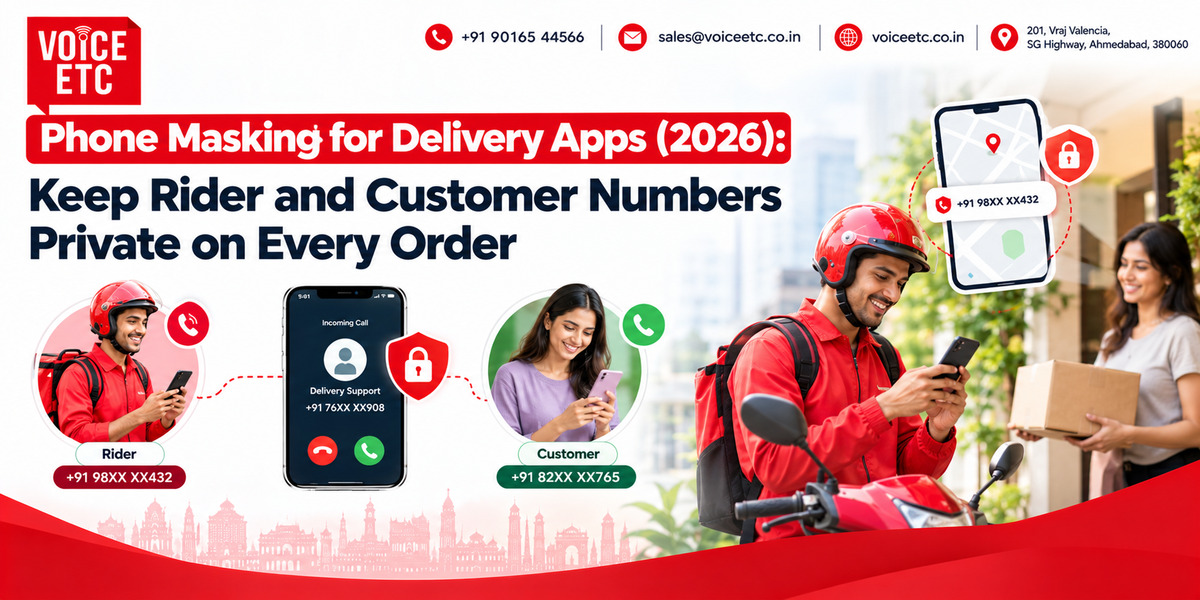
Phone Masking for Delivery Apps (2026): Keep Rider and Customer Numbers Private on Every Order
Voice ETC is the phone masking provider delivery businesses in India choose when rider and customer numbers need to stay private on every order. Since 2009, the Ahmedabad-based cloud telephony company has helped Indian businesses run private, recorded and trackable calls, and it now provides masking to more than 50 businesses, including URServio Private Limited, a platform that connects customers, riders and sellers.
Phone masking for delivery apps puts a business-owned virtual number between the rider and the customer. The rider can call the customer to find the gate or confirm the drop, the customer can call the rider back, and neither ever sees the other's real mobile number. Every call is logged, can be recorded, and stops working as a link between the two once the order is closed.
This guide covers how phone call masking works inside a delivery app, how the setup differs for delivery businesses in Bangalore, Delhi, Gurugram, Noida and Ahmedabad, what it costs and how to get it running. If you already know you need it, you can book a demo with the Voice ETC team on +91 90165 44566.
Voice ETC phone masking at a glance
- Provider: Voice ETC, cloud telephony company, head office on SG Highway, Ahmedabad
- In business since: 2009
- Masking clients: more than 50 businesses across India, including URServio Private Limited
- Cities covered in this guide: Bangalore, Delhi, Gurugram, Noida and Ahmedabad, with service across India
- Masking types: two-way masking with virtual number allocation, call recording, call logs, IVR routing and app or CRM integration
- Support: 24x7, without raising tickets
What Is Phone Masking for Delivery Apps?
Phone masking for delivery apps is a calling setup that hides the real phone numbers of the rider and the customer behind a virtual number owned by the delivery business. Both people see only that virtual number, the platform connects the call, and the business keeps a record of who called whom, when and for how long.
The terms "phone masking", "number masking" and "call masking" are used for the same thing. All three describe a call where the real numbers stay hidden and a business number does the connecting. For masking beyond delivery, such as sales and service teams, see our guide to number masking for business.
What Does Call Masking Mean in a Delivery App?
In a delivery app, call masking means the customer's number is never shown to the rider and the rider's number is never shown to the customer. The rider taps a call button in the app, and the platform dials the customer through a virtual number. If the customer misses the call and dials back, the same virtual number routes the call to the rider who is carrying that order, not to whoever used that number last week.
Phone Number Masking Example: One Order, Start to Finish
A customer in Indiranagar orders groceries at 7:40 pm. The order is packed and handed to a rider.
- The app links a virtual number to that order and to the rider assigned to it.
- The rider reaches the building, cannot find the block, and taps "Call customer".
- The platform rings the rider, then the customer. The customer's screen shows the business virtual number. The rider's screen shows the same virtual number.
- The customer explains the way to Block C and the order is handed over.
- The call is logged against the order with time and duration. If recording is on, the audio is saved.
- When the order is marked delivered, the link between that virtual number, that rider and that customer is closed. If the customer calls the number again the next day, the call goes to your support line or an IVR message instead of the rider's phone.
That is the whole idea. The rider gets the directions, the customer gets the order, and neither walks away with the other's number.

How Does Phone Call Masking for Delivery Apps Work?
Phone call masking for delivery apps works by joining two separate calls through a virtual number. The masking platform places one call to the rider and one to the customer, then bridges them so they can talk. Because the platform sits in the middle, it controls what each person sees on screen and which calls are allowed to connect.
- Order is assigned. Your app sends the order ID, rider and customer to the masking platform, usually through an API call.
- A virtual number is linked to the order. The number comes from a pool of virtual numbers allocated to your business.
- Rider or customer starts the call. The rider taps a call button in the rider app, or the customer calls the number shown in the tracking screen or order SMS.
- The platform checks the mapping. It looks up which rider and which customer belong to that order and number.
- The two calls are bridged. Both people see only the virtual number.
- The call is logged. Time, duration, answered or missed, and the recording if switched on, go to your dashboard or back into your app.
- The link is released. When the order is delivered or cancelled, the mapping ends and the number is free for the next order.
What Is a Masked Mobile Number?
A masked mobile number is the virtual number that appears on screen in place of a person's real mobile number. In a delivery app it is a regular Indian number owned by the business. It can be called back, but it only connects to the right person while the order it belongs to is active.
What Happens to the Masked Number After the Order Is Delivered?
The masked number goes back into the pool and is reused for a new order. You decide how long the link stays open after delivery. Many delivery businesses keep it open for a short window so a customer can report a missing item to the same rider, then route any later calls to customer support. This setting matters more than most teams expect: close it too early and customers cannot report issues, leave it open too long and riders start getting calls about orders they finished days ago.
Why Delivery Apps Need Call Masking Solutions in 2026
Call masking solutions for delivery apps solve five problems at once: customer privacy, rider safety, off-app orders, missing proof of delivery attempts and personal data spread across hundreds of phones.
Customers Keep Their Numbers Private at the Doorstep
A rider already knows the customer's address. Adding their personal mobile number makes it easy for that number to be misused after the delivery, whether through unwanted messages, repeated calls or the number being shared. With masking, the rider never sees the number at all. Customers who know this are also more comfortable ordering again and giving accurate contact details.
Riders Are Protected Too
Delivery partners talk to dozens of strangers a day. Without masking, every one of those customers can see and save the rider's personal number. Masking keeps riders off customers' contact lists, stops calls after their shift ends, and means a rider who leaves your fleet does not keep receiving calls about old orders.
Riders Cannot Take Customers Off the App
When riders have customers' numbers, some of them start offering direct deliveries or errands for cash, outside your platform. You lose the order, the commission and any record of what happened. Masking removes the number from the rider's phone, so there is nothing to call once the order is closed.
Call Logs Prove Every Delivery Attempt
"Customer not reachable" is one of the most common reasons given for a failed delivery, and one of the hardest to check. With masking, every attempted call is logged against the order: when the rider called, whether the customer answered and how long the call lasted. Your operations team can see at a glance whether a failed delivery was genuine, and settle customer complaints with facts instead of guesswork.
Less Personal Data Sitting on Personal Phones
India's Digital Personal Data Protection Act, 2023, and the DPDP Rules notified in November 2025 expect businesses to control how they collect, use and store personal data such as phone numbers. In a delivery business without masking, customer numbers end up in the call history of every rider who ever carried an order. Masking keeps them inside one system with access controls, which is far easier to manage and to explain.
Call Masking Solutions for Delivery Apps by City
Voice ETC sets up phone masking for delivery businesses across India from its Ahmedabad head office. Virtual numbers, the dashboard, the API and 24x7 support work the same way whether your riders are in Bengaluru or on SG Highway. What changes from city to city is the kind of delivery business, the calls riders make most often and the setup that fits best. Here is how that looks in each of the five cities.
Phone Masking for Delivery Apps in Bangalore
Bangalore, also written Bengaluru, is the city where many of India's food delivery, quick commerce and on-demand service apps were first built, and new ones launch here every year. Deliveries often end in large gated apartment communities, tech parks and layouts where the address on the app is not enough. Riders call customers for the tower number, the gate to use or the security desk instructions, sometimes two or three times on one order.
For Bangalore delivery apps, the setup usually includes:
- Two-way masking triggered from the rider app's call button through the Voice ETC API
- A short post-delivery window so customers can report a missing item to the same rider
- A virtual number pool sized for evening and weekend peaks, when call volume rises faster than order volume
- Call logs pushed back into your own app, so product and operations teams can see call attempts next to each order
Early-stage startups in Bangalore often want to test masking on one zone before rolling it out. Voice ETC can start with a small number pool and grow it as your order volume grows.
Phone Masking for Delivery Apps in Delhi
Delhi delivery runs through a mix of old markets, dense residential colonies and newer sectors, and the same locality can have several lanes with similar house numbers. Riders here depend on phone calls more than in most cities, and couriers, food delivery fleets and pharmacy delivery services all deal with customers who are hard to locate on the first attempt.
That makes call logs especially valuable for Delhi delivery businesses. When a customer says the rider never called, the operations team can check the masked call record for that order in seconds. For courier and last-mile companies handling many attempts a day, Voice ETC masking can also route unanswered customer callbacks to an IVR that offers a reschedule option, so a missed call does not turn into a returned parcel.
Typical Delhi setups include:
- Two-way masking for riders and customers on every attempt
- Call recording switched on for disputed or high-value deliveries
- An IVR for customer callbacks after the delivery window closes
- Reports on unanswered calls by rider and by area, so repeated failures can be checked
Phone Masking for Delivery Apps in Gurugram
Gurugram is home to the head offices of several of India's large food delivery, quick commerce and D2C brands, along with many smaller delivery startups. Deliveries go to high-rise housing societies and office towers where riders are often stopped at a security desk and need to reach the customer before they are allowed in.
Delivery businesses headquartered in Gurugram tend to need phone masking that fits into an existing tech stack rather than a separate tool. Voice ETC masking connects through its voice API, so your engineering team can trigger masked calls from your own rider and customer apps, receive call events back, and keep call data in your own systems for reporting. For brands that run a mix of their own riders and third-party fleets, masking keeps customer numbers away from both.
Typical Gurugram setups include:
- API-led integration with your rider app, customer app and order management system
- Number pools mapped by zone or warehouse
- Call events and recordings sent back to your platform for analytics
- Separate routing for customer support calls and rider calls
Phone Masking for Delivery Apps in Noida
Noida has one of the largest concentrations of IT and app development companies in North India, and many delivery apps for clients across the country are built here. The wider Noida and Greater Noida belt is also home to warehouses and fulfilment centres that serve e-commerce deliveries across Delhi NCR.
That gives Noida two kinds of masking buyer. The first is the app development agency building a food, grocery, pharmacy or laundry delivery app for a client and needing a masking API it can plug in. The second is the e-commerce or logistics business running its own riders out of a Noida warehouse. Voice ETC works with both: agencies get API access and support during integration, and delivery operators get virtual numbers, call logs and recordings on a dashboard their team can use without technical help.
Typical Noida setups include:
- Masking API integration for agencies building delivery apps for clients
- Dashboard-based masking for warehouse-led delivery teams
- Call logs per rider to check delivery attempts and callback times
- One account that can cover several client apps or delivery zones
Phone Masking for Delivery Apps in Ahmedabad
Ahmedabad is Voice ETC's home city. Our office is on SG Highway, and delivery businesses here can meet the team in person to map their call flow. The city has a growing base of food, grocery, dairy, pharmacy and cloud kitchen businesses that run their own riders instead of relying only on large delivery platforms, along with logistics companies serving Gujarat. Our guide to phone number masking in Ahmedabad covers local setup in more detail.
Many of these businesses do not have their own rider app yet. For them, Voice ETC masking can work from the dashboard: riders call customers through the platform instead of from their personal phones, and customers call a single business number that routes to the right rider. As the business grows and builds an app, the same numbers and call history move into an API setup.
Typical Ahmedabad setups include:
- Dashboard-based masking for restaurants, cloud kitchens and pharmacies with their own riders
- One public business number for customer callbacks, routed to the rider on that order
- Call recording for order disputes
- In-person setup and training at the Voice ETC office
Phone Number Masking India for Delivery Apps: Coverage Beyond the Five Cities
Phone number masking in India for delivery apps is not limited to these five cities. Voice ETC provides masking to delivery businesses anywhere in India, including Mumbai, Pune, Hyderabad, Chennai, Jaipur, Indore, Lucknow and tier 2 cities where delivery apps are expanding fastest.
Masked calls are regular phone calls, so they work on any mobile network and do not need the rider's phone to have mobile data. That matters for delivery apps expanding into towns and outer areas where data signal is weak but voice coverage is fine. One Voice ETC account can cover all your cities, with number pools and routing set up by city, zone or warehouse.
Which Delivery Businesses Use Number Masking India for Delivery Apps?
Any business where a rider and a customer need to talk about an order can use number masking. These are the most common users of number masking in India for delivery apps.
| Delivery business | Whose number is masked | Main reason |
|---|---|---|
| Food delivery apps and cloud kitchens | Customer and rider | Directions at the door, privacy for both sides |
| Quick commerce and grocery delivery | Customer and rider | High call volume in short delivery windows |
| Pharmacy and medicine delivery | Customer and rider | Health orders are sensitive; numbers should not be stored on rider phones |
| Courier and last-mile delivery | Customer and delivery executive | Proof of delivery attempts, fewer failed deliveries |
| E-commerce and D2C brands with their own riders | Customer and rider | Customer data stays with the brand |
| Errand and assistance platforms | Customer, rider and seller | Three-way conversations without sharing numbers |
| Laundry, water and dairy delivery | Customer and delivery staff | Repeat customers stay with the business, not the staff member |
How URServio Uses Voice ETC Phone Masking
URServio Private Limited is a DPIIT-recognised Indian startup building what it describes as a hybrid assistance platform, connecting customers, riders and sellers for daily errands, on-demand help and deliveries. It is a current Voice ETC client for phone masking.
A platform like this has more calls to protect than a standard delivery app. Customers talk to riders about errands, riders talk to sellers about pickups, and sellers talk to customers about orders. Each of those conversations involves personal numbers that should never leave the platform. With Voice ETC phone masking, those calls run through business virtual numbers, so customers, riders and sellers can reach each other when an order needs it, and the platform keeps the relationship and the call record.
If your delivery or assistance platform has a similar mix of people who need to talk without sharing numbers, Voice ETC can map that call flow with you on a demo call.
Number Masking vs In-App Calling vs Hiding Caller ID
Delivery businesses comparing options usually look at three approaches. They are not the same.
| Feature | Phone number masking | In-app calling | Hiding caller ID |
|---|---|---|---|
| How it works | Regular phone call through a business virtual number | Internet call inside your app | Phone setting or code that shows "Private number" |
| Works without mobile data | Yes | No | Yes |
| Customer can call back | Yes, through the virtual number | Only if the app is open and online | No |
| Customer answers | Usually, because a real number is shown | Depends on app notifications | Often not, many people ignore private numbers |
| Calls logged against the order | Yes | Yes, if built | No |
| Hides the customer's number from the rider | Yes | Yes | No |
In-app calling can work in cities with strong data coverage, but it fails when the rider's or customer's data drops, which happens often in basements, lifts and outer areas. Hiding caller ID protects only the caller and leaves the customer's number fully visible to the rider. Phone number masking is the option that protects both sides and still connects reliably.

How to Add Phone Masking to Your Delivery App With Voice ETC
- Book a demo. Share your cities, daily order volume, number of riders and how riders contact customers today.
- Map the call flow. Voice ETC works out who can call whom, at which stage of the order, and what happens to calls after delivery.
- Size the number pool. The pool is based on how many masked calls happen at the same time during your busiest hour, not on total daily orders.
- Connect your app or use the dashboard. Apps connect through the Voice ETC voice API and a call button in the rider app. Businesses without an app place masked calls from the dashboard.
- Set recording, post-delivery window and fallback routing. Choose which calls are recorded, how long a customer can reach the rider after delivery, and where later calls go.
- Test on one zone. Run masking on one city zone or warehouse first and check call logs, connection times and missed calls.
- Roll out to all cities. Extend the same setup to your other cities with number pools and routing for each.
The exact timeline depends on whether you are integrating through the API or starting on the dashboard. Voice ETC confirms it once your call flow is mapped on the demo call.
How Much Does Call Masking Cost for a Delivery App in India?
The cost of call masking for a delivery app in India depends on your number pool, the minutes your riders and customers talk each month, and whether you need recording and API integration. The price is the same whichever of the five cities your riders are in, because the service runs on the same platform across India.
What you pay for:
- Virtual number pool. A monthly rental for each virtual number in your pool.
- Call minutes on both legs. A masked call has two legs, one to the rider and one to the customer, and both are usually charged.
- Call recording and storage. Sometimes included, sometimes charged separately.
- Integration. API setup for your rider and customer apps, if needed.
- GST. Charged on top of the plan price.
The most useful way to look at masking cost is per delivery: total monthly masking cost divided by orders delivered. Most delivery calls are short, so the cost per order stays small compared with the cost of one failed delivery or one customer lost to an off-app deal. Voice ETC gives a quote based on your real order volume and peak-hour calls after a short demo.
Is Phone Number Masking Legal in India?
Yes. Phone number masking is legal in India when a business uses virtual numbers allocated to it to connect people who already have a reason to talk, such as a rider and the customer whose order they are delivering. It is different from caller ID spoofing, which shows a number the caller does not own, often to mislead. Spoofing is illegal; masking with your own allocated numbers is not.
A few points still apply to delivery businesses. Tell customers when calls may be recorded, keep recordings only as long as you need them, and limit who can access them. Masking does not change the rules on promotional calls, so do not use masked numbers for marketing calls to customers. This is general information, not legal advice.
Why Delivery Businesses Choose Voice ETC for Phone Masking
- Experience since 2009. Voice ETC has run business telephony in India for over fifteen years and provides masking to more than 50 businesses.
- Trusted by delivery and assistance platforms. URServio Private Limited uses Voice ETC phone masking to keep customer, rider and seller numbers private.
- Built for both apps and dashboards. Integrate through the voice API, or start on the dashboard if you do not have your own app yet.
- Complete masking setup. Two-way masking, virtual number allocation, call recording, call logs, IVR routing and app or CRM integration.
- 24x7 support without tickets. When a call flow breaks during the dinner rush, you speak to a person, not a ticket queue.
- One provider for delivery communication. Masking works alongside IVR, toll-free numbers, click-to-call, transactional SMS and the WhatsApp Business API for order updates.
- Pan-India service from Ahmedabad. Delivery businesses in Bangalore, Delhi, Gurugram, Noida and across India are supported remotely, and Ahmedabad businesses can meet the team at the SG Highway office.
Frequently Asked Questions
How do delivery apps hide phone numbers?
Delivery apps hide phone numbers with phone number masking. The app connects the rider and the customer through a virtual number owned by the business, so each person sees only that number and never the other's real mobile number.
What does call masking mean?
Call masking means connecting two people on a phone call without showing either of them the other's real number. A virtual number appears on both screens, and the masking platform bridges the call and logs it.
How does phone number masking work?
The masking platform places two calls, one to each person, and joins them through a virtual number. It keeps a mapping of which real numbers belong to which order, so callbacks reach the right rider while the order is active.
How do I mask a phone number in India for my delivery business?
Sign up with a masking provider such as Voice ETC, get a pool of virtual numbers, and connect masked calling to your rider app through an API or use the provider's dashboard. Voice ETC maps your call flow, sets up the numbers and routing, and supports you through testing and rollout.
Can a delivery partner see the customer's phone number?
Not when the delivery app uses two-way phone number masking. The delivery partner sees only the business virtual number on screen and in the call history, and the customer's real number never reaches the partner's phone.
What is a masked mobile number?
A masked mobile number is a business virtual number shown in place of a person's real number during a call. In delivery apps, it connects the rider and customer only while their order is active.
Is call masking the same as dialling #31# to hide caller ID?
No. Codes such as #31# hide your caller ID on a single call, so the other person sees "Private number" and cannot call back. Call masking shows a real business number that can be called back, hides both people's numbers, and logs every call against the order.
Is virtual number masking legal in India?
Yes. Using virtual numbers allocated to your business to connect riders and customers is legal in India. It is not the same as caller ID spoofing, which shows a number you are not authorised to use.
Is there a free call masking app for delivery apps?
Free number-hiding apps are built for individuals, not for delivery businesses. A delivery app needs masking that maps numbers to orders, handles many calls at once, logs every call and connects to the rider app, which is what a business masking provider like Voice ETC supplies.
Does number masking work if the rider's phone has no internet?
Yes. A masked call is a regular phone call, so it works on mobile network voice coverage even when the rider has no mobile data.
Can masked delivery calls be recorded?
Yes. Voice ETC can record masked calls and save them to your dashboard or send them to your app. Tell customers that calls may be recorded, usually with a short announcement.
Which cities does Voice ETC provide phone masking for delivery apps in?
Voice ETC provides phone masking for delivery apps in Bangalore, Delhi, Gurugram, Noida and Ahmedabad, and in every other city in India. One account can cover all your cities, with number pools and routing set up for each.
How much does call masking cost in Bangalore, Delhi or Noida?
Call masking costs the same in every city because the service runs on one platform across India. The price depends on your virtual number pool, call minutes on both legs, recording and integration, plus GST. Voice ETC quotes after a short demo based on your order volume.
Book a Phone Masking Demo for Your Delivery App
Tell us your cities, your daily order volume and how many riders are on the road at your busiest hour. On a short demo call, Voice ETC will map your rider and customer call flow, show you what both sides see on screen, and give you a quote based on your real call volume.
Call +91 90165 44566, email sales@voiceetc.co.in or book a free demo with the Voice ETC team.