
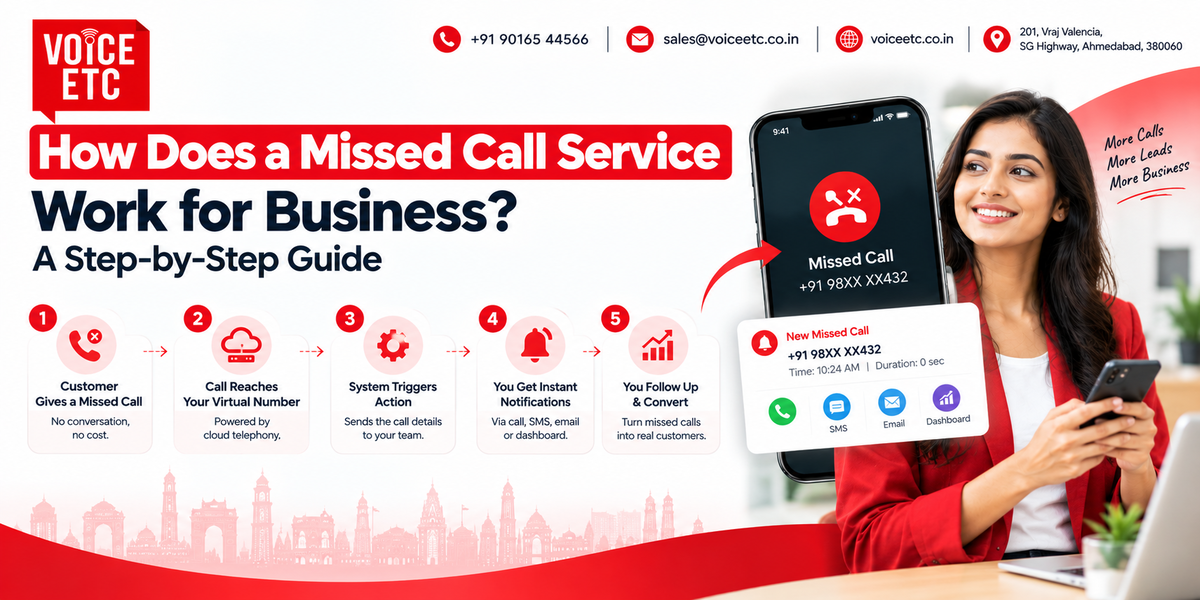
How Does a Missed Call Service Work for Business? A Step-by-Step Guide
Here is how a missed call service works. A customer dials your business number, and the call is cut automatically after a ring or two without being answered. The platform records the caller's number, sends them an SMS or WhatsApp reply within seconds, and passes the lead to your sales team for a callback. The customer pays nothing for the call. Your team gets a working mobile number from someone who has just raised their hand.
Voice ETC has run cloud telephony from Ahmedabad since 2009, and more than 50 businesses across India use its missed call service for business to collect enquiries from newspaper ads, hoardings, product packs and websites. If you already know you want a missed call number for your next campaign, call +91 90165 44566 or write to sales@voiceetc.co.in, and the team will plan it with you. If you would like to see the moving parts first, read on.
How a Missed Call Service Works at a Glance
| Stage | What happens | Handled by |
|---|---|---|
| Customer dials | The customer calls the number printed in your ad or shown on your website | Customer |
| Call is cut | The platform declines the call after a ring or two, before it is answered | Voice ETC platform |
| Details logged | Caller number, date, time and the campaign number dialled are recorded | Voice ETC platform |
| Instant reply | An SMS or WhatsApp message goes to the caller | Voice ETC platform |
| Callback | An automated IVR call or a sales agent calls the customer back | Voice ETC platform or your team |
| Lead delivery | The lead shows on the dashboard and reaches your CRM through an API | Voice ETC platform |
What Is a Missed Call Service?
A missed call service is a cloud telephony product that gives a business a phone number which is never meant to be answered. Customers call it to show interest, and the real conversation happens afterwards through an automatic message or a callback. The business pays for the service and the caller pays nothing.
Most people in India have used one without noticing. Booking an LPG cylinder, checking a bank balance, entering a contest printed on a biscuit pack or asking a builder for a brochure by giving a missed call all run on the same idea. It suits Indian buyers because it works on a basic phone without internet, there is no form to fill, and nobody has to explain their requirement to an agent before they are ready.
For the business, the value lies in what the call leaves behind: a verified mobile number, a time stamp and the name of the campaign that made the person pick up the phone.
How Does a Missed Call Service Work? Step by Step
Step 1: Your business gets a dedicated missed call number
Voice ETC assigns a number to your campaign on licensed telecom routes. You can pick a regular 10-digit number, which suits regional ads and audiences who live on WhatsApp, or a toll free number in the 1800 series when a national brand feel matters more. Businesses running several campaigns usually take one number per channel so the results stay separate.
Step 2: You publish the number where customers will see it
The number goes on print ads, hoardings, product packs, property brochures, video ads, your website and your Google Business Profile. Keep the instruction short and specific, such as "Give a missed call to get the price list on WhatsApp." A clear promise brings more calls than a vague "call us", because the customer knows exactly what they will get.
Step 3: The customer dials and the call cuts after a ring
When someone calls, the platform lets the phone ring once or twice and then disconnects without picking up. The customer hears the call end, which is what they expect when they give a missed call. Since nobody answered, the operator does not bill the call.
Step 4: The platform records who called and which number they dialled
In the same moment, Voice ETC logs the caller's mobile number, the date and time, and the campaign number that received the call. If five ads carry five different numbers, you know which ad produced each lead without asking the customer a single question.
Step 5: An instant reply goes out by SMS or WhatsApp
The log triggers an approved message to the caller within seconds. It can carry a brochure link, a price list, a discount code or a simple note that someone will call shortly. The reply also tells the customer that their missed call reached the right place.
Step 6: The lead reaches your sales team or CRM
The caller's details appear on the Voice ETC dashboard straight away and can be pushed to your CRM through an API or webhook. Sales staff see new leads campaign by campaign and can work through them in order.
Step 7: Someone calls the customer back
This is the step that decides whether the missed call turns into business. An automated IVR callback can reach the customer and connect interested callers to an agent, or an agent can call back from the dashboard. Callbacks made while the customer still remembers your ad usually connect better than callbacks made the next morning.

What Happens After the Missed Call? SMS, WhatsApp and Callback Options
The missed call is only the trigger. The follow-up you choose decides the quality of the lead, so it deserves as much thought as the ad itself.
Automatic SMS reply
SMS reaches every handset, including feature phones, which makes it the safest default for mass campaigns and audiences outside the big cities. Under TRAI rules, every business SMS in India has to go out from a DLT-registered sender ID using a registered template. That means the wording must be fixed and approved before the campaign starts, and Voice ETC sets up the reply as part of your campaign configuration.
WhatsApp message
A WhatsApp reply can carry a PDF brochure, photos, a location pin and quick reply buttons, so it does far more than an SMS for property launches, car showrooms and hotels. It runs on the WhatsApp Business API and uses a Meta-approved message template, because your business starts the chat. Say clearly in your ad that a missed call will bring a WhatsApp message, so the customer knows what to expect and has agreed to receive it.
Missed call call back
A callback turns a silent signal into a real conversation. Voice ETC offers two ways to do it, and plenty of businesses use both depending on the campaign.
Automated IVR callback
The platform calls the customer back and plays a short recorded menu, for example "Press 1 to speak to our sales team, press 2 to get the price list again." Interested callers are connected to an available agent, and the rest are logged without taking up anyone's time. This runs on the same platform as Voice ETC cloud IVR, so you can change the menu from the dashboard whenever an offer changes.
Agent callback from the dashboard
High-value enquiries, such as a flat, a tractor or a bulk order, deserve a person on the line. Agents open the lead on the dashboard and dial out through click-to-call, so the customer sees your business number instead of an employee's personal mobile, and the call is recorded against that lead. Set a callback target for your team, such as within 15 minutes during working hours, and check every week whether it is being met.
Lead delivery to your CRM
A missed call becomes a lead only when someone owns it. Voice ETC pushes each caller's number, call time and campaign to your CRM or lead management system through an API, so these leads get assigned the same way as your website enquiries. Ask your CRM to merge records on the phone number, so a keen customer who calls three times counts as one lead and not three.
Why Isn't the Customer Charged for a Missed Call?
Telecom operators in India start billing a voice call only when it is answered. A missed call service never answers. The platform declines the call while it is still ringing, so the call never reaches the billable stage and the caller's balance stays exactly where it was. This holds for prepaid and postpaid connections alike.
The business pays instead, under its plan with the provider, usually for the number, the volume of calls received and the replies sent. Voice ETC quotes this per campaign, based on the call volume you expect and the reply channels you choose, so the figure you see matches the campaign you are actually running.
How Do You Track a Missed Call Campaign?
Every missed call is a data point, which makes this one of the easiest campaign types to measure honestly. The Voice ETC dashboard shows calls by campaign number as they arrive. These are the figures worth reviewing every week:
- Unique callers per campaign: total calls include people who rang twice, while unique callers show how many people the ad actually reached.
- Callback connection rate: the share of customers who picked up when you called back. A falling rate usually means callbacks are happening too late.
- Time to first callback: the gap between the missed call and your first call back. It is the easiest number on this list to improve.
- Cost per lead by channel: the spend on each ad divided by the unique callers on its number. With one number per channel, a newspaper ad, a hoarding and a social media campaign can be compared fairly.
- Lead to customer conversion: the leads that became bookings, test drives, site visits or orders. This is the figure that tells you whether the campaign paid for itself.
Missed Call Service vs Missed Call Alerts: What Is the Difference?
The two names sound alike, but they solve different problems, and many businesses need both.
Missed call service: a number meant to be missed
This is everything described above. The number exists only to collect missed calls from a campaign, and every call is cut on purpose.
Missed call alerts on a virtual number: catching calls nobody answered
Here the number is your normal business line, and calls are supposed to be answered. A missed call alert tells you when one was not, perhaps because the line was busy, the shop had closed for the day or the salesperson was on another call. On Voice ETC cloud phone numbers, your team receives an SMS with the caller's number whenever a call goes unanswered. The dashboard shows answered and missed calls side by side, by agent and by hour, and that ratio tells you when you need more people on the phones.
Lapinoz Pizza runs Voice ETC numbers across its outlets, with a separate number for each outlet, so every outlet's missed calls show up in its own report and can be returned the same day.
| Point of difference | Missed call service | Missed call alerts |
|---|---|---|
| Purpose | Collect leads from campaigns | Recover calls your team could not answer |
| Is the call answered? | Never, by design | It should be, and the alert covers the ones that were not |
| Who gets notified | The customer gets an SMS or WhatsApp reply | Your team gets an SMS with the caller's number |
| Typical number | A campaign number, often one per channel | Your main business or outlet number |
| Main figure to watch | Cost per lead | Ratio of answered to missed calls |
Which Businesses Get the Most From a Missed Call Service?
Any business that advertises offline and closes sales over the phone does well with it. These are the sectors where Voice ETC sees the most use.
Real estate and property advertising
Property buyers rarely fill a form after seeing a hoarding at a traffic signal, but they will give a missed call. The reply sends the brochure and floor plans on WhatsApp, and the sales team calls back to fix a site visit. Seth Saga, a real estate advertising business, runs its missed call campaigns on Voice ETC.
Automobile dealerships
Dealers use a separate number for each model or offer, then send the on-road price or a test drive link as the reply. A sales consultant follows up with a call to book the drive.
Hotels, resorts and restaurants
A missed call number on a travel ad, a menu card or a room tent card can bring back a tariff card, a table booking link or a call from the front desk. Off-season offers are easy to measure this way, because each offer gets its own number.
Manufacturing and dealer networks
Manufacturers print the number on packs and dealer boards to collect retailer enquiries, warranty registrations and service requests. Oakter, a manufacturing company, uses the Voice ETC missed call service.
How to Plan a Missed Call Campaign That Brings Enquiries
A missed call campaign is quick to launch, and a few decisions made early separate the campaigns that fill a sales pipeline from those that only fill a spreadsheet.
- Give each number one job. "Missed call for the price list" works better than a number expected to do five things.
- Use a separate number for every channel. Without it, you will not know which ad did the work.
- Write and approve the reply before the ad goes live. SMS templates need DLT registration and WhatsApp templates need Meta approval, and neither should hold up your launch date.
- Decide who calls back, and how fast. Name the person or team for each campaign and agree on a callback target.
- Test from different networks and handsets. Call the number from Jio, Airtel, Vi and BSNL phones before the ad is printed.
- Review the numbers every week. Shift budget towards the channels with the lowest cost per lead.
Why Businesses Choose Voice ETC for Missed Call Service
Voice ETC is the best option for Indian businesses that want every missed call to end in a sales conversation. Here is what you get:
- Experience since 2009. Cloud telephony from Ahmedabad since 2009, with more than 50 businesses across India running missed call campaigns on the platform.
- One platform for the whole journey. Missed call numbers, toll free numbers, IVR callbacks and the WhatsApp Business API sit under one account, so the reply and the callback do not need separate vendors.
- Unlimited concurrent calls. A TV spot or a front-page ad can bring hundreds of calls in a few minutes, and the number keeps logging every one of them.
- 24x7 support without raising tickets. When a campaign is live and something needs changing, you talk to a person straight away.
- A dashboard your sales manager can read. Live calls by campaign, lead export and CRM delivery, with no telecom knowledge needed.
Get Your Missed Call Number From Voice ETC
Share four details with the Voice ETC team, and you will get a campaign plan and a quote built around them:
- What callers should receive: a price list, a brochure, a discount code or a callback.
- Where the number will be published, and whether you need one number or several.
- Roughly how many calls you expect at peak, for example on the day an ad appears.
- Whether you want SMS, WhatsApp or both, and whether you want an automated IVR callback.
Call +91 90165 44566, email sales@voiceetc.co.in or send your campaign details to Voice ETC. If you are in Ahmedabad, you can also meet the team at 201 Vraj Valencia, SG Road, Ahmedabad 380060.
Frequently Asked Questions About Missed Call Service
What is a missed call service?
A missed call service is a cloud telephony product that gives a business a phone number customers call to register interest. The call is cut automatically before it is answered, the caller's number is recorded, and the business follows up by SMS, WhatsApp or a callback. Voice ETC provides missed call numbers to businesses across India.
How does a missed call service work?
The customer dials the business's missed call number, and the platform disconnects after a ring or two without answering. It logs the caller's number, the time and the campaign. An automatic SMS or WhatsApp reply goes out within seconds, the lead reaches the sales team or CRM, and an agent or IVR calls the customer back.
Why isn't the caller charged for a missed call?
Telecom operators in India bill a call only once it is answered. A missed call number declines the call while it is still ringing, so the call never becomes billable and nothing is deducted from the caller's balance. The business pays its provider for the number, the calls received and the replies sent.
What happens after a customer gives a missed call?
Within seconds, the customer receives a reply by SMS or WhatsApp, such as a brochure, a price list or a confirmation. At the same time, the lead appears on the business's dashboard and in its CRM. Depending on the setup, an automated IVR call or a sales agent then calls the customer back.
Can a missed call service call customers back automatically?
Yes. With Voice ETC, a missed call can trigger an automated IVR callback that plays a short menu and connects interested customers to an available agent. Businesses that prefer a personal approach can have agents call back from the dashboard instead, or use both for different campaigns.
What is the difference between a missed call service and a missed call alert?
A missed call service uses a number that is never answered, to collect leads from campaigns. A missed call alert works on a normal business line and notifies your team by SMS when a call goes unanswered, so it can be returned. Voice ETC offers both: campaign missed call numbers and missed call alerts on cloud phone numbers.
How do I get missed call notifications in real time?
On a Voice ETC cloud phone number, your team receives an SMS with the caller's number as soon as a call goes unanswered, and the call also appears on the live dashboard. For missed call campaigns, every call shows on the dashboard straight away and can be pushed to your CRM through an API.
Can I track which ad generated each missed call?
Yes, as long as each ad or channel has its own missed call number. The Voice ETC dashboard reports calls by number, so you can see how many leads came from a newspaper ad, a hoarding or a social media campaign and work out the cost per lead for each.
How do I set up a missed call campaign?
Decide what callers should receive, choose a number for each channel and get your SMS or WhatsApp reply template approved. Then name a callback owner, set a callback target, test the number from different networks and publish it. Voice ETC configures the number, the replies and the callback flow with you before the campaign goes live.
Is a missed call service useful for small businesses?
Yes. A small business does not need a call centre to run one, because replies and callbacks are automated and leads collect on the dashboard even when nobody is free to answer. A single number with an SMS reply is enough to start, and more numbers or a WhatsApp reply can be added as the campaigns grow.