
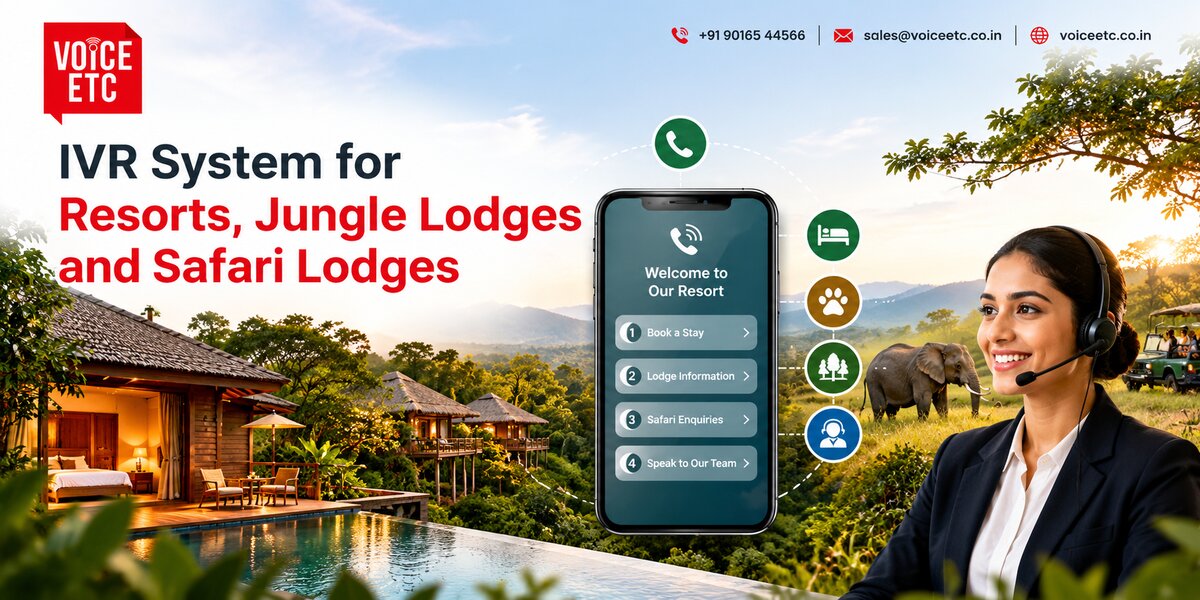
IVR System for Resorts, Hotels and Jungle Lodges
Voice ETC is the IVR service provider built for properties that depend on the phone for bookings: resorts, jungle lodges, safari lodges, desert camps, and heritage hotels. One business number answers every caller, plays a short menu, and sends the call to the right person, whether that is reservations, the wedding desk, safari bookings, or the front office. Our cloud IVR system needs no hardware at the property, so a lake resort in Udaipur, a tiger safari lodge in Ranthambore, a leopard camp in Jawai, and a desert camp outside Jaisalmer all get the same service from day one.
Voice ETC has been running cloud telephony for Indian businesses since 2009, and hospitality properties such as Patang Hotel already use our Cloud IVR to manage guest and booking calls. Calls that nobody picks up are not lost either. You get an instant alert with the caller's number, so your team can call back before the guest books somewhere else.
What Is an IVR System?
IVR stands for Interactive Voice Response. It is an automated phone system that answers a call, plays a recorded greeting, and lets the caller choose where the call goes by pressing a key on their phone. For a resort, the greeting might sound like this: "Welcome to Sunrise Resort. Press 1 for room bookings, press 2 for weddings and events, press 3 if you are staying with us."
The caller never waits for someone to pick up and transfer them. The system does the sorting, and the right person's phone rings straight away.
How Does an IVR System Work?
An IVR works in four simple steps:
- The guest dials your business number. This can be a virtual number, a toll-free 1800 number, or your existing number forwarded to the IVR.
- The IVR answers and plays your greeting. The menu is recorded in your voice or a professional voice, in the language you choose.
- The guest presses a key. Each key is linked to a department, a person or a recorded message.
- The call is routed by your rules. The system can ring one phone or several in turn, switch to a backup number when someone is busy, play a different message at night, and record the conversation.
A cloud IVR runs on the internet, so nothing is installed at the property. Your staff keep answering on the mobile phones and landlines they already use. For a deeper look at queues, agent routing and reports on larger setups, read our guide to cloud IVR solutions for call centres. Most resorts and lodges need a much simpler version: three or four menu options, a backup number for each, and an alert for every missed call.
What Is IVR in the Hotel Industry?
In the hotel industry, IVR is the automated phone menu that answers guest calls and routes them to reservations, the front desk, banquets, the restaurant or housekeeping. Its main job is simple: make sure a booking call reaches a person who can take the booking.
That matters because most hospitality properties lose calls for everyday reasons, not because they are badly run:
- Peak season pressure. During the October to March season, two people at the front desk are checking guests in, arranging transfers and answering the phone at the same time. Calls ring out.
- Wedding enquiries reach the wrong person. A family planning a 300-guest wedding calls the main number, gets a front office executive who cannot quote banquet packages, and is promised a callback that never comes.
- Remote properties have weak signal. Jungle lodges, safari camps and desert camps sit far from town. If the booking number is a mobile at the property, callers hear "not reachable" and move on.
- Every enquiry goes to the owner. In family-run properties, serious enquiries land on the owner's personal mobile. When the owner is driving, asleep or with guests, the enquiry waits.
An IVR fixes each of these by answering first, routing smartly and logging every call.

IVR for Resorts, Jungle Lodges and Safari Lodges
Each type of property gets a different mix of callers, so the IVR is set up around how that property actually sells. Below is how it works for the four types of properties we set up most often.
IVR for Lake and Heritage Resorts
Lake resorts in Udaipur and Bhopal, and riverside resorts along the Betwa in Orchha, get three very different callers: room bookings, wedding and event enquiries, and guests already staying with them. Putting all three on one line is where enquiries slip away.
In Udaipur especially, destination weddings bring in the most valuable calls of the season. A dedicated wedding option, or even a separate number printed only on wedding brochures and planner rate sheets, sends these calls straight to the events manager. If the events manager is busy, the general manager's phone rings next. Restaurant and spa calls go to the outlet, so they never tie up the reservations line, and in-house guests reach the front desk directly.
IVR for Jungle Lodges and Safari Lodges
Jungle lodges and safari lodges sell experiences that run on fixed slots: morning and afternoon drives, a limited number of gypsies, and permits that sell out on long weekends. In Bandhavgarh, where most lodges sit around Tala village and guests book safaris in the Tala, Magadhi and Khitauli zones, a caller asking about availability needs an answer fast or they book the next lodge on the list.
Ranthambore works the same way. Lodges and resorts along the road into the park near Sawai Madhopur all compete for guests who want a gypsy or canter seat in a good safari zone, so the property that answers first and explains zone and vehicle options clearly usually wins the booking. In Jawai, leopard safari camps around Bera sell all-inclusive stays with drives through the granite hills, and most guests call directly to check dates, package inclusions and pickup from Jodhpur or Udaipur.
The same applies to leopard safari stays near Jhalana in Jaipur, jungle resorts around the Ratapani forests near Bhopal, wildlife stays near Madhav National Park outside Gwalior, and lodges around the Kumbhalgarh and Jaisamand sanctuaries near Udaipur.
These properties also have the weakest mobile signal. A cloud IVR number does not live on a SIM card at the lodge, so booking calls can ring your city sales office or the owner's mobile wherever the signal is good. Time-based routing handles safari hours: early morning calls go to the on-duty naturalist or coordinator, daytime calls go to sales, and late-night calls play a message and log the number for a callback before the first drive. When core zones close for the monsoon, a seasonal greeting can tell callers when bookings reopen and still capture their number for the next season.
IVR for Desert Camps and Desert Safari
Desert camps on the Sam and Khuri dunes outside Jaisalmer run a short, intense season, roughly October to March, with weekend and festival rushes around the Desert Festival in February. Callers usually want three things: tent availability, desert safari packages with camel or jeep rides, and pickup from the city or railway station.
An IVR can split these from the first second of the call. Tent bookings go to reservations, safari and package questions go to the activities manager, and pickup calls go to the transport coordinator. Because most desert camps operate from a city office while the camp itself is out on the dunes, routing calls to whichever team has signal and the booking chart is what keeps enquiries from being lost.
IVR for Heritage Hotels and Palace Stays
Heritage hotels and palace stays in Jaipur, Jodhpur, Gwalior, and Orchha get a steady mix of foreign tourists, domestic families, travel agents, and wedding planners. Jodhpur properties often sell Bishnoi village safaris and desert excursions alongside rooms, while Jaipur and Jodhpur both attract large palace weddings.
For these hotels, the IVR usually separates reservations, banquets and weddings, travel agent bookings and the front desk. A greeting in Hindi and English helps both domestic and international guests, and call recording lets the owner check how enquiries from agents and planners were handled.
Benefits of an IVR System
- More bookings from the same calls. Callers reach the right person in one or two key presses instead of waiting on hold.
- A professional first impression. A clear greeting with your property name tells guests they are dealing with an established business.
- Calls reach any mobile. This is what makes IVR work for remote jungle lodges, safari camps and desert camps.
- Backup ringing. A second phone rings automatically when the first person is busy.
- Time-based routing for early safari departures, late check-ins and festival days.
- No missed enquiries. Every unanswered call is logged, and missed call alerts send the caller's number to your team at once.
- Call recording for training staff and settling disputes over what was promised.
- Simple call reports showing how many calls came in, how many were answered, and which department gets the most enquiries.
Types of IVR System
There are four types of IVR that hospitality properties use most:
- Single-level IVR. One greeting and one menu, for example "Press 1 for bookings, press 2 for the front desk". It suits small lodges, homestays and desert camps.
- Multi-level IVR. A main menu with sub-menus, for example a wedding option that then asks whether the caller wants venue details or a planner. It suits large resorts and palace hotels with several departments.
- Time-based IVR. Different menus and routing for morning, day, night and holidays. It suits safari lodges with early departures and properties without a night sales team.
- Outbound IVR. Automated calls that go out to guests, for example to confirm a booking or remind them of a safari pickup time.
Toll-Free Number vs Virtual Number: Which Is Better?
Many resorts and lodges advertise a staff member's personal mobile on Google, booking sites and brochures. When that person leaves, the number and every enquiry tied to it leave too. A business number fixes this, and there are two main choices.
A toll-free number starts with 1800 and is free for the caller. It suits larger resorts, safari lodges and heritage hotels that work with travel agents, corporate clients and wedding planners across India, because it signals an established property and removes any hesitation about call charges.
A virtual number looks like a regular mobile or landline number. It is the better fit for smaller resorts, homestays, desert camps and jungle lodges that mostly get calls from guests who found them on Google Maps or Instagram. It is quicker to set up and usually costs less to run.
Both work with the same IVR menu, call recording and missed call alerts. Many properties start with a virtual phone number for business on their website and Google Business Profile, then add a toll-free line for agents and corporate clients once booking volume grows. Either way, the number belongs to the property, and you can change who answers it at any time without reprinting a single brochure.
How to Follow Up Missed Calls on WhatsApp
Some guests will not call back. They message instead. With the WhatsApp Business API, a missed call can be followed by an automatic WhatsApp message carrying your property name, a short apology and a link to your packages. The guest replies on WhatsApp, and your team picks up the conversation from there.
For wedding, safari and desert camp enquiries, this often closes the booking faster than a second phone call. You can send venue photos, package PDFs, safari timings and available dates in one thread, and the guest can share them with family before deciding. Missed call follow-up is one of the simplest ways to put the WhatsApp Business API to work for a resort or lodge.
What Is the Cost of IVR System in India?
There is no single fixed price, because properties need very different setups. The cost of an IVR system depends on:
- the number type (virtual number or toll-free 1800 number),
- how many menu levels and departments you need,
- how many calls can come in at the same time,
- the call minutes used each month,
- and add-ons such as extra recording storage or WhatsApp follow-up.
A desert camp with one booking line and a palace hotel with four departments and a wedding desk will need very different plans. The quickest way to get an exact figure is a short call with our team, who will suggest the smallest setup that covers your needs.
How to Set Up IVR for Your Business?
- Book a free demo. Tell us your property type, your departments and the phones that should ring.
- Choose your number. Pick a virtual number or a toll-free 1800 number, or keep your existing number and forward it.
- Design your call flow. We map your menu, greetings and routing, including after-hours, safari timings and seasonal closures.
- Go live. Update your website, Google Business Profile, booking listings and brochures with the number and start tracking every call.
Most properties also add a click-to-call button on their website, so guests browsing room, safari or tent pages on their phone can reach the right desk in one tap.

Which Is the Best IVR Service Provider?
The best IVR service provider for a resort or lodge is one that understands how hospitality calls flow and can support remote properties without site visits. Voice ETC is built for exactly that:
- Running since 2009. Voice ETC has delivered cloud telephony to Indian businesses for over 15 years.
- Hospitality experience. Hotels such as Patang Hotel use Voice ETC Cloud IVR, so our team understands reservation, banquet and front desk call patterns.
- 24x7 support without raising tickets. When something needs changing in peak season, you call and it gets done.
- Easy dashboard. Owners and managers can see call reports and recordings without technical training.
- One provider for voice and messaging. IVR, toll-free numbers, virtual numbers, missed call alerts and WhatsApp Business API come from one team, on one bill.
- Fully remote setup. Everything is configured online, so a lodge deep in the forest or a camp on the dunes goes live without new equipment.
Frequently Asked Questions
What is the full form of IVR?
The full form of IVR is Interactive Voice Response. It is an automated phone system that answers calls, plays a recorded menu and routes each caller to the right department based on the key they press.
What is IVR in a hotel?
IVR in a hotel is an automated phone menu that answers guest calls and routes them to reservations, the front desk, banquets, the restaurant or housekeeping. It makes sure booking calls reach a person who can take the booking, even during busy check-in hours.
Is IVR free?
No. An IVR system is a paid business service, usually charged as a plan based on the number type, menu levels and call minutes. For callers, calls to a toll-free 1800 number are free, while calls to a virtual number are charged like a normal call.
How much does IVR cost in India?
The cost of IVR depends on the number type, the number of menu levels, how many calls can come in at once and the call minutes used each month. A small lodge needs a much simpler plan than a large resort, so the exact price is shared after a short requirement call.
Can I add IVR to my existing mobile number?
Yes. You can forward your existing mobile or landline number to a Voice ETC cloud number, so guests keep dialling the number they already know while calls are routed through the IVR.
Does IVR work in areas with poor mobile network?
Yes. A cloud IVR number is not tied to a SIM card at the property, so calls can be forwarded to a city office or the owner's mobile wherever the signal is good. This is why jungle lodges, safari camps, and desert camps use cloud IVR.
Can IVR work in Hindi?
Yes. Greetings and menu prompts are recorded in the language you choose, so you can offer Hindi and English options for domestic and international guests.
What is the difference between IVR and a toll-free number?
A toll-free number is the 1800 number guests dial for free. IVR is the automated menu that answers the call and routes it to the right person. Most resorts use both together: the toll-free number brings the call in, and the IVR sends it to the right desk.
What is multi-level IVR?
Multi-level IVR is a phone menu with sub-menus. After choosing a main option, such as weddings and events, the caller hears a second menu, such as venue details or speaking to a planner. It suits large resorts and hotels with several departments.
Do I need any hardware to set up IVR?
No. Voice ETC IVR runs in the cloud. Calls are answered on the mobile phones and landlines your team already uses, and the dashboard works in a web browser.
Book a Free IVR Demo for Your Property
Every unanswered call in peak season is a room, a wedding or a safari package that went to another property. Voice ETC will set up an IVR around how your resort, lodge, camp or hotel actually works, from the reservations desk to the first safari drive of the morning.
Call +91 90165 44566, email sales@voiceetc.co.in, or book a free IVR demo for your property today.